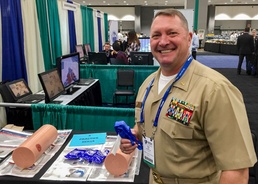
Top leaders from Navy Medicine Operational Training Center (NMOTC) attended the 2018 International Meeting on Simulation Healthcare (IMSH) in Los Angeles earlier this year.
Representatives from each of NMOTC’s six detachments participated in education sessions instructed by healthcare simulations experts and colleagues from around the world. Each session was designed to allow participants to pass on what they learned when they return to their business or workplace.
“The best thing about the IMSH conference is that it allowed us to talk to other military members and find out what type of training they are doing,” said Cmdr. Christopher Niles, NMOTC’s training director. “Simulation is the new standard of medical training, and when I attend conferences like these, I use it as an opportunity to compare what is happening at my command with what everyone else is using all around the world.”
Niles added that with the rapid rate of breakthroughs in simulation, it can be easy for medical training facilities to fall behind the curve. He says attending conferences like these allows for NMOTC to stay on top of cutting-edge technology and state-of-the-art techniques to assure the best possible medical training is being provided at all times.
“Five or 10 years ago you’d see something that would essentially just be a big plastic mannequin,” said Niles. “Now you can pretty much simulate any type of resuscitative or trauma injury and even do actual surgery on the simulation equipment. This type of leap in technology gives personnel going through training more confidence when they go through our courses.”
NMOTC created the Navy’s first Role II Light Maneuver (R2LM) course in July 2017 and is currently working on similar new courses to enhance the future of Navy Medicine. Attending the conference with NMOTC colleagues helped Niles get fast and efficient feedback from fellow leaders. He said being able to immediately speak face-to-face with his co-workers who are usually spread across the country made for a more impactful experience.
“Every one of our detachments uses simulation equipment,” said Niles. “Having a representative from each detachment gave us a chance to learn something new and then share it with fellow leaders in real-time.”
Niles said that along with the learning opportunity the IMSH provided, having NMOTC attend the conference also allowed closer alignment with NMOTC and the Navy Surgeon General’s Strategic goals of Readiness, Health and Partnerships.
“Improving our training programs will improve our ability to take care of our warfighters,” said Niles. “Seeing what’s current in the civilian and military sector and working with them to ensure we stay innovative greatly improves both our partnerships and readiness.”
Navy Medicine Operational Training Center is part of a health care network of Navy medical professionals around the world who provide high-quality health care to more than one million eligible beneficiaries. Navy Medicine personnel deploy with Sailors and Marines worldwide, providing critical mission support aboard ships, in the air, under the sea, and on the battlefield.