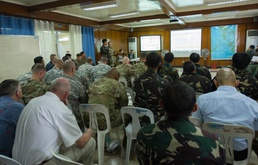
CAMP EMILIO AGUINALDO, Philippines – A combined U.S. and Armed Forces of the Philippines team conducted a Combined Arms Rehearsal, April 8th, in preparation for an upcoming operation on the island of Panay.
The CAR is part of the planning phase for Operation Handa Koa. It is led by the Philippines and is being held in support of Balikatan 2016, a bilateral training exercise that helps maintain a high level of readiness and enhances military-to-military relations and combined combat capabilities.
“Handa Koa is an operational level mobility exercise. So we’re not really focused on the actions of an individual platoon or company, in the jungle or in an urban area,” said Lt. Col. Eric Anderson, chief of operations, 25th Infantry Division. “We’re focusing on broad operational movements. So being able to move services across a country, deploy them, and then have them arrive synchronized with other forces on a single objective.”
One of the newest implementations for this year’s exercise is a Joint Rapid Reaction Force. The JRRF is a concept required by the AFP who is tasked with the execution of Operation Handa Koa. The main objective of the JRRF is to demonstrate partnered capability in a rapid response scenario.
“So each year the exercise evolves and becomes more advanced, and this year the level of the command post exercise is at the joint task force level, that’s an important development. That’s happened before but this year a little more sophisticated, a little more advanced in terms of the training objectives,” said Brig. Gen. Patrick Matlock, 25th Infantry Division, commanding general. “We also have this combined operation, this joint combined operation that we are conducting live, it’s the first one that we’ve done.”
The U.S. and the Philippines have a longstanding partnership that dates back 65 years. However, working through the cultural barriers of different services can be difficult.
“Operation Handa Koa is a very complicated exercise so there are a lot of challenges. Back in the U.S. it’s always a challenge just to integrate our forces or our branches within a service,” Anderson said. “So now we’ve got to synchronize our plans and our operations across all of our services Army, Navy, Airforce, Marines within the U.S., and then synchronize it bilaterally with our Philippine forces. Converging on one objective on one island or many islands away from where we are staging or planning this operation.”
Maintaining a high-level of readiness and enhanced military-to-military relations is a key objective for the exercise Balikatan 2016.
“Well the first measure of success is always bilateral exercise is to build a relationship with our host nation. So we have a great relationship with the Philippine armed services, the armed forces, and we always want to make sure that relationship ends every exercise stronger than when we began,” Matlock said. “So that’s our number one training objective, it always will be, and we’re well on our way of meeting training objective this exercise.”
Balikatan is an annual training exercise that strengthens the interoperability between the Armed Forces of the Philippines and U.S. military in their commitment to regional security and stability, humanitarian assistance and disaster relief.