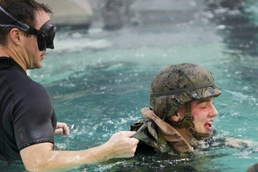
MARINE CORPS BASE CAMP LEJEUNE, N.C. – As the amtrac dunker dropped in the pool, flipped over on its side and began to take on water all spectators breathlessly waited for the four “trapped” Marines to resurface.
With air bubbles disturbing the calm water, everyone in the pool let out a sigh of relief as they watched the four Marines escape the Submerged Vehicle Egress Trainer and float to the surface.
“I honestly hope the Marines never have to use any of the training they learned today,” said Glen LaMarque, an underwater egress instructor here.
The day’s training was to teach basic egress from a submerged vehicle. Though this “amtrac dunker” is not an exact replica of an AAV, it can be flipped on its side or upside-down to simulate what happens when a vehicle loses power and is engulfed by water.
“The front half (of the simulator) is the cab of a Humvee, and the back an AAV,” said LaMarque, a native of St. Augustine, Fla. “The inside isn’t as complicated as an actual AAV, but it still allows the Marines to receive proper training.”
The Marines completed the training wearing full water gear, including breathing devices, life vest and flak jackets.
Before using the SVET simulator the Marines were taught in pairs, and practiced proper use of air-tanks, and escaping from a mock AAV seat.
“I was a little nervous at first, but after being in the water and practicing, it wasn’t as hard as I thought,” said Lance Corporal Kristopher Ax a crewman with Charlie Company.
Though Ax feels this training is beneficial, he said he’s not looking to there being a time when what he’s learned is needed.
“There’s no doubt that what we are doing today is probably some of the most useful training we’ll receive,” said the Fair Lawn, N.J. native. “But if there is a time when I have to use this (training) that probably means things are already going bad.”
This survival training proves to be not only beneficial for junior Marines but for senior enlisted as well.
“It keeps us on our toes,” said Staff Sgt Peter L. Roger, a section leader with Charlie Company. “If we don’t know how to keep our senses and escape a sinking AAV, how can we expect it of the younger Marines?”
Roger said that the training was more than just about water survival.
“It’s not just about getting the certification,” said Roger a native of Wichita Falls, Texas. “It’s about the Marines being comfortable while still being able to deal with tragedy.”
As the SVET simulator emerged from the water for the final time, the Marines exited the pool with a sense of relief and accomplishment.
“At the end of the day, if a Marine leaves this class with a certification card, then there’s no doubt that he is capable of successfully performing these survival skills,” said LaMarque.