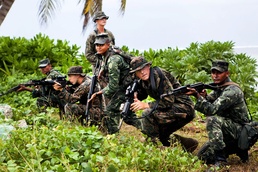
GAN, Republic of Maldives – Silently, a small group of Maldivian Marines creep through the tree line of coconut groves that border the Maldivian coastline. Their black boots land softly, but move swiftly, as they maneuver to their rally point.
Upon arrival, they lay alert in a circular formation and begin systematically tapping ankles of the Marine next to them to signify they are present. The fire team is up, and all Marines are accounted for.
Maldivian and U.S. Marines exchanged tactics for maintaining troop accountability here Oct. 9 as part of Exercise Coconut Grove 2012, a bilateral training event conducted bi-annually between the U.S. Marine Corps and the Maldivian National Defense Force.
During this segment of training, the Marines moved to their rally point, condcuted a leader’s reconnaissance of the objective area and rehearsed troop accountability procedures for the marshalling area control officer (MACO), who is responsible for keeping a critical count of Marines involved in landing zone operations.
“It’s important because we always need to have accountability of all Marines and sailors as they leave either the landing zone for helicopters or the beach landing zone site for small boats,” said 1st Lt. Andrew Mirsch, a platoon commander with Company A, 1st Battalion, 4th Marine Regiment. “(The MACO protocol) is just our simple procedure to make sure that we get back all the Marines that we take down range to the objective.”
After practicing together, the Marines became fluent with each other’s procedures, effectively accounting for each Maldivian and U.S. Marine.
“Rehearsing this together, making sure that every single Marine knows their individual job, ensures that we have cohesion as a unit,” Mirsch said. “We can move from one place to another effectively and efficiently without losing a Marine or any gear.”
Besides enhancing cohesion between the two militaries, U.S. Marines were also able to gain familiarity with tactics the Maldivian Marines use in jungle-like terrain, a skill that Mirsch says Marines haven’t practiced on a large scale since the Vietnam era.
“We’re operating in (the Maldivian’s) backyard right now, and their tactics for small units in the jungle, at night, are definitely things that we can pick up and learn,” said Mirsch. “Their time-tested and true procedures for operating in the jungle that they’ve developed after living here for years, I would say are head and shoulders above our own.”
Coconut Grove 2012 will conclude Oct. 17, with a combined amphibious raid scheduled as the exercise’s culminating event.