By Sgt. Maurice Smith
3rd Brigade Combat Team, 25th ID Public Affairs
KIRKUK, Iraq – It's an unmistakable sound heard throughout the land Coalition Forces have been fighting to stabilize for the past few years. In just an instant, the roar from an improvised explosive device explosion injures innocent Iraqi citizens.
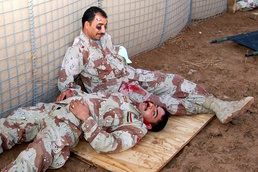
Mass casualty situations in Iraq can leave hospitals overwhelmed. On the same day where a car bomb killed 10 Iraqis and injured more than 40 outside of a police station in Kirkuk, Jan. 17, the medics of 2nd Brigade, 4th Iraqi Army Division, were training at K-1 Military Base to respond and save lives during these types of crises.
"Today was a [Mass Casualty] exercise," said Capt. Charles Douglas, company commander, C Company (Charlie Med), 325th Brigade Support Battalion, 3rd Infantry Brigade Combat Team. "The simulation today was supposed to be an IED or an explosion, resulting in a catastrophic event where there were approximately 24 casualties," he added.
The casualties were spread throughout a maze of barriers for this scenario, with 1-5 Iraqi soldiers around each corner, portraying civilians with various injuries ranging from head trauma to uncontrolled or internal bleeding, multiple fractures, amputations and even death.
Simulation or not, it was quite the challenge for the Iraqi medics as they responded without knowing how many people were injured, the extent of their injuries and how much equipment to bring.
"It's supposed to be surprising," said Pfc. Nakea Griggs, evacuation medic, C Company, 325th BSB. "We were trying to get them ready for this when it actually does happen," said Griggs.
"They didn't know what type of enemy they were facing. They didn't know how many people were out there and what type of injuries they had. They were just supposed to go out there blindfolded, pretty much," she added.
Even with uncontrolled confusion, these Iraqi medics did not panic because with the help of coalition forces, they've been training for months on how to handle catastrophes such as this.
"We deal with emergency cases the correct way –stopping bleeding, opening airways, also giving [the injured] IVs and oxygen, said Warrant Officer Arie Anwar, medic, 2nd Brigade, 4th IAD. "We have a good idea on how to deal with [mass casualties] now. We have that feeling and know the conditions," he said.
Douglas and his medical company have been working with their Iraqi counterparts since September of last year, after the 101st Airborne Division transferred responsibility of Kirkuk province to 3rd IBCT. Vast improvements have been made in just a matter of months. Their communication and casualty evacuation procedures are better, and most importantly, so are their life saving skills. With their capabilities growing each day, Douglas believes that the drive toward Iraqi independent operations starts and continues throughout the country with exercises like this.
"They get increased competence, proficiency and confidence in their job so they can actually perform this without any sort of assistance," said Douglas.
"They've made a major improvement from when we first took on the role of mentoring and training them as a clinic. I've seen the progress of not just focusing on the day-to-day [training] but also focusing on training requirements for the future, which is going to set them up for their ability to conduct self-sustaining operations without the assistance of CF."
"Some of these leaders today will end up turning into leaders down the road in other areas of Iraq as well. So what we do in one isolated pocket of Iraq can eventually spread to other areas," he said.
"It's something that I'm very proud to see. They are taking the initiative on taking the lead because that's what our ultimate goal is."