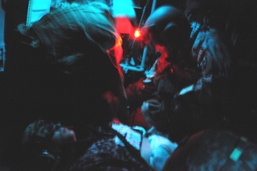
FORT PICKETT, Va. — Soldiers of the 7236th Medical Support Unit participated in Exercise Southbound Trooper, Feb. 18-26, 2012, a coalition-joint exercise, providing the opportunity to operate and train with the Canadian army and U.S. military forces in an effort to develop their medical techniques, skills and procedures while building a strong partnership.
Lt. Col. David Thompson, commander of the 7236th MSU, has prepared and planned for this exercise since July 2011. As commander, much of his focus is on professional development of his soldiers through quality and realistic medical training while supporting and assisting the joint forces.
“We were chosen for this mission because our main focus has been training and our unit has developed a good reputation for training hard,” said Thompson. “My top three priorities have been soldier readiness, competence in warrior tasks and competence in Tactical Combat Casualty Care.”
Thompson added, “I am passionate about TCCC.” He explained the three major injuries that lead to preventable death on the battlefield. “There is bleeding out from an extremity wound, dying from an unrecognized tension pneumothorax, or collapsed lung, caused by a penetrating or blunt chest injury, and airway problems.”
The exercise had both day and night live fire air missions, bringing together Canadian Joint Terminal Attack Controllers, an U.S. Army ground medical team and Navy Sea Hawks to practice casualty evacuations as part of the live fire exercise.
“We shouldn’t have soldiers die due to bleeding out,” said Thompson, a native of the Eastern Shore of Maryland. “Every deployed soldier is issued an individual first aid kit, and trained on how to provide care under fire, tactical field care and casualty evacuation care.”
Exercise Southbound Trooper provides the opportunity for Canadian Infantry soldiers to train in a tactical environment and be sustained by service support personnel, ranging from military police, transportation, quartermaster, communications, and medical assets, to name a few.
The 7236th MSU, South East Medical Area Readiness Support Group is from Fort Bragg, N.C., The SE-MARSG is one of six commands that fall under the Army Reserve Medical Command. This is the first time the MSU has had this type of training opportunity with joint and coalition forces.
The exercise challenged soldiers in all areas of medical training; they were faced with mass casualty events, medical evacuations by air and ground, tending to injured soldiers while traveling by air, both day and night, and setting up and utilizing a mobile medical in an austere environment.
Pvt. Jean Claude Gravel, a medic with 33rd Field Ambulance from the Canadian army out of Halifax, Nova Scotia, observed that the U.S. Army has different techniques of medical practices in comparison to the Canadian army.
“I learned a lot of procedures, like, getting in and out of a C-130 military aircraft; recognizing the four different types of heartbeats and air-way inhalations.” said Gravel. “I was thrilled to work with the U.S. Army, and I am really looking forward to training with them again!”