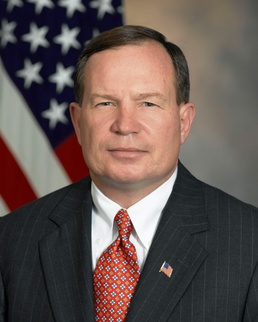
FORT BRAGG, N.C. – No one in the Army knows more about environmental sustainability than Tad Davis, the chief executive officer for the Army Reserve.
So much so, the General Electric Ecomagination Team selected Davis as one of its top sustainable innovators for 2011 with the GE Ecomagination award.
According to the company’s website, the GE Ecomagination award demonstrates the Army’s commitment to imagine and build innovative solutions to today’s environmental challenges while driving economic growth.
Even though the award recognizes Davis individually, he said the award is the result of many soldiers and civilians within the Army Reserve who deserve the credit.
“I don’t accept this award on behalf of myself but on behalf of the literally hundreds of dedicated Army soldiers, civilians and families – active, guard and reserve – that are really working hard each and every day to bring sustainability to the forefront of what we are doing,” Davis said. “It may be a personal recognition for me but it’s more a recognition for the Army as a whole.”
He added what the Army is doing in the realm of sustainable resources directly benefits the nation.
“We’re finally getting recognition for the work we’ve been engaged in for a decade,” he said.
Davis acknowledged that senior Army leaders have noticed how changes in environmental sustainability, energy security, and conservation relate to mission accomplishment in both contingency missions abroad and installation activities back home.
“We’re faced with a tremendous decrease in the defense budget over the next couple of years,” Davis said. “When you consider how much money we’re investing in utilities – electricity, water, waste water, solid waste disposal – if there are things that we can do to reduce those costs and continue operations that will be a huge benefit to us as a military.”
Environmental sustainability is nothing new for Davis, whose military and civilian career spans three decades.
While serving as Fort Bragg’s garrison commander from 2000-2003, Davis realized that paying the installation’s utility bills went hand-in-hand with conserving resources on the sprawling 160,000-acre post.
He highlighted his time as post commander in three defining moments: the re-establishment and recovery of the endangered Red Cockaded Woodpecker population in the training areas; paying the post’s monumental energy bills each month; and finally, dealing with record drought conditions which threatened the normal 8 million gallons of water used in day-to-day operations.
Through these three environmental events, Davis helped establish the Sustainable Fort Bragg Initiative, a pilot program that has been mirrored at over 30 installations nationwide and a number of state National Guard organizations, he said.
From this effort, he co-founded the Sustainable Sandhills program with communities surrounding Fort Bragg. This grassroots effort addressed common issues of mutual concern such as air quality, water quality and quantity, waste disposal and energy consumption.
Davis said the issues have evolved over time but the group is “still up and running today as a champion for sustainability here in the Sandhills.” Of note, Sustainable Sandhills has fostered the sustainability spirit locally by “certifying” well over 100 “green businesses” in the region.
Now, as the Army Reserve Command’s chief executive officer and the director of its services and infrastructure core enterprise, Davis is again leading the way in sustainability.
Davis said the Army Reserve is more than soldiers, their families and the Civilian workforce. It is an extensive organization that owns and manages well over 1,200 brick-and-mortar facilities located around the globe. These facilities are largely based in communities, not behind the fences of traditional military installations. The environmental impact on these communities is what drives Davis toward better environmental stewardship.
The Army Reserve is implementing a number of measures to improve the overall efficiency of its operations while simultaneously enhancing the quality of life which includes efforts to reduce greenhouse gas emissions or our “carbon boot print,” Davis said.
By using SMART metering initiatives to monitor energy consumption at its facilities, the Army Reserve is taking a proactive approach to limit energy usage.
Another initiative under the Army’s Net-Zero energy program is installing photovoltaic solar panels at installations such as Fort Hunter Liggett, Calif., to generate electricity to limit the post’s dependence on the local electrical grid. Solar grids are also being installed at the 99th Regional Support Command headquarters at Joint Base McGuire-Dix-Lakehurst, N.J., and Fort Buchanan, Puerto Rico.
A third initiative is having any new Army Reserve construction or building renovations certified by the Leadership in Energy and Environmental Design standards. Davis said LEED rates construction in silver, gold or platinum certifications and is the “green building standard” here in the United States as laid out by the Green Building Council.
Over the last two years, Davis said the Army Reserve has required all construction projects to be at least silver certified by LEED.
He said many of the new construction projects have been designed to be energy efficient during peak and non-peak hours, thereby driving down energy consumption and operating costs.
Davis said the Army Reserve is also harnessing wind power in Butte, Mont., to utilize renewable energy.
“We just opened a new (reserve) center up there that has the LEED design configuration but they also have a wind turbine that’s producing 20 to 25 percent of their power for the building,” he said. “When you have an area that has the wind capacity it makes all the sense in the world.”
Dependency on the grid is a concern for the Army Reserve in the Pacific region with facilities in Guam, Hawaii, and Saipan, Davis said, especially after the earthquake and resulting tsunami in Japan last year.
“As a result of that natural disaster, we’re seeing increased energy costs at our facilities in Guam and Saipan. We’re going to be putting a more concerted effort how can we place photovoltaic panels to provide solar power to offset some of the costs,” he said.
While spending in a time of shrinking defense budgets may concern some, Davis said the return on investment is what needs to be considered when weighing energy security options.
Many of the options come from public-private partnerships that provide the construction capital the military wouldn’t otherwise have, he said.
“We get upgraded systems, we’re reducing our energy costs, in some case we’re reducing our dependency on the grid and fossil fuel and we’re reducing greenhouse gases,” Davis said. “We are trying to reduce our carbon foot print, which we affectionately refer to as our carbon boot print … which is huge. We have to do our part just like everybody else.
“There is no silver bullet to environmental sustainability and energy security,” Davis said. “You’ve really got to come at it in a broad way and look at all aspects of what resources we’re consuming out there and what can we do to be better stewards of the taxpayers’ dollars.”