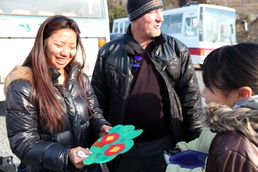
OSHIMA ISLAND, Japan – As the ferry grew closer to the dock of Oshima Island, two of its occupants began to get anxious. Standing on the second level of the ferry, Raymond W. Richards and his wife Motoko, braved the intense cold in hopes of getting that first glimpse of a member of their family they had only spoken to over the phone.
The two arrived on the island after a long day of traveling, which included a 5 o’clock show time, a three-hour flight and a three-hour bus ride. Now, the 20-minute ferry is all that stood in their way.
As the ferry docked and passengers began to offload, the couple was welcomed with open arms by Naoko Kikuta, a resident of Oshima Island.
Although they had never met in person, the three shared a special bond created by tragedy.
Immediately following the March 11, 2011, earthquake and tsunami, U.S. service members sprang into action, and at the request of the government of Japan, began providing disaster relief support to the people of Japan. Oshima Island was on the long list of places that needed help. Kikuta’s family was displaced and struggled to get their lives back in order.
A few months later, Kikuta received word that the Okinawa-based Marines wanted to open their homes to 25 children and four chaperones for a few days away from the devastated island.
This initiative was dubbed the homestay program, and Richards and Motoko were one of several families on Okinawa who volunteered.
The goal of the program was to provide temporary relaxation for children affected by the earthquake and tsunami and was symbolic of the affection and friendship between the people of Japan and the United States, according to Dr. Robert D. Eldridge, deputy assistant chief of staff, G-7, Marine Corps Installations Pacific.
“I was grateful my children were provided an opportunity to leave, even if it was just for a short period of time,” said Kikuta, mother of two homestay program participants. “The [volunteers] took care of the children as their own, and that meant a lot.”
Kikuta’s two children left Oshima Island to experience temporary relief and build a mutual trust and partnership between the U.S. and Japan. They did not expect to create a family while doing so.
“When my wife and I made the decision to open our homes to these two young ladies, we knew it was a commitment we were making for the rest of our lives,” said Richards.
Richards and his wife maintained contact with the two children, talking to them at least once per week after the visit was over and said it was truly a pleasure to have been a part of something so special.
Nearly five months later, III Marine Expeditionary Force and MCIPAC leadership decided to visit the island to evaluate the progress of restoration. Richards and Motoko accompanied the group.
The visit to Oshima Island provided homestay volunteers an opportunity to reunite with the children they brought into their homes and allowed some to meet their families.
“It brought tears to my eyes when I saw the kids reunite with their homestay families,” said Hironobu Sugawara, a member of Kesennuma City and head of the delegation committee for the homestay program. “Words can’t express how I feel about the homestay program.”
It built an everlasting relationship between families, he added.
“When I saw Raymond and Motoko, and we met for the first time, it was like I already knew them. They weren’t strangers to our family,” said Kikuta. “We don’t see them as the family that volunteered … we see them as family.”