by Sgt. 1st Class Jennifer Schwind
CENTCOM Public Affairs
CAMP TAJI, Iraq -- It's not your typical backdrop for a finishing school: sand, equipment and up-armored HUMVEES. The Phoenix Academy at Camp Taji, Iraq, also referred to as the "Finishing School," provides transition teams with final formal and refined training before they spend up to a year embedded with the Iraqi Security Forces (ISF).
"Our overall strategy in Iraq, as you've heard the President say many times, is that we're going to stand up the Iraqi Security Forces -- and as they do, we'll stand down. This transition team concept is an integral part of our entire strategy," said Army Gen. George W. Casey, Jr., commanding general of Multi-National Forces-Iraq (MNF-I).
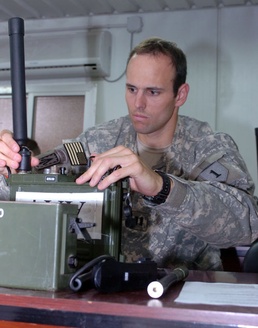
As the final formal training for the teams, the Phoenix Academy builds on the generalized Iraq information, maneuver training and basic combat skills of the first three phases, and focuses on specific advanced instruction. Its curriculum includes counter-insurgency, ethics, communications equipment and tracking devices. Transition teams who are finishing their tours also come in to speak about lessons learned in their areas of operation.
"The Phoenix Academy is our last chance to work with them on the advisory skills, cultural skills and organization of the Iraqi Security Forces to make them aware of the situation in the specific area they're going to," said Army Lt. Col. Kevin West, training officer for the IAG.
"This is the phase in which they receive all the advanced instruction that they require for mission success once they depart here," said commandant of the Phoenix Academy, Marine Lt. Col. John R. Studt. "This is the final place they go to before they actually proceed out in the field to begin their mission with their respective Iraqi counterparts."
The transition team mission is to advise, coach, teach and mentor the ISF. They are sourced by all four military services, although Soldiers and Marines primarily make up the teams.
To prepare for their advisory roles, teams go through a total of five training phases. Even before leaving home station, they complete the first phase, which consists of mandatory read-ahead material. Phase two, lasting 45 to 60 days, is focused on manning and equipping the teams, as well as training them on topics such as language, combat skills, force protection and team support processes. It is held at Fort Riley, Kan., for Army, Navy and Air Force personnel and at Twentynine Palms and Camp Pendleton, Calif., for Marines.
After stateside training is complete, they travel to Camp Buehring, Kuwait, for five days of in-theatre orientation. The Phoenix Academy is the fourth phase, lasting eight to 10 days. Finally, the transition teams enter a 10-day "left seat/right seat" phase in which they overlap with the 10-15 member Military Transition Team (MiTT), Border Transition Team (BTT), or National Police Transition Team (NPTT) they will replace, as well as meet their Iraqi counterparts. This is referred to as "RIP/TOA," short for "relief in place, transfer of authority."
With the command emphasis that is clearly placed on the transition team mission, the training at the Phoenix Academy receives close attention too. The commanding generals of MNF-I, Multi-National Corps-Iraq (MNC-I), and the IAG schedule visits to address each transition team at the academy.
"I think it's very important -- the fact that the senior leadership here ... takes the time to personally brief the transition teams coming through the Phoenix Academy," said Army Brig. Gen. Dana J. H. Pittard, commanding general of the IAG. "Part of this is to make sure everyone knows how important that mission is. Our embedded transition teams truly are the decisive effort."
During his visits to teams at the academy, the MNC-I commanding general, Army Lt. Gen. Peter W. Chiarelli, provides an overview of the current battlefield situation and emphasizes the importance of establishing relationships with the Iraqi forces by embedding with them.
"What you really have to do in this country is try to win their trust and confidence," Chiarelli said. "I think you can win the trust and confidence of people by being with them in this society."
In order to do this, teams must adapt to the Iraqi culture. Muhammad Qutish, instructor of the cultural awareness class at the academy, points out the importance of understanding the differences between the two cultures so that Americans don't unknowingly offend Iraqis.
For example, he said, while chewing tobacco is accepted in Iraq, spitting can pose a problem. If an Iraqi sees someone spit on the street, he may think he was being spat at, and therefore disrespected. Since honor is a big part of Iraqi culture, a simple misunderstanding like this could escalate to a bigger issue.
"It is very important to take that into consideration because things could go wrong if misunderstood," Qutish said. "If he was good guy, now he will be a bad guy and he will fight."
Beyond being aware of and adapting to the culture in which the teams will live and work, the teams must be ready to embrace advisory roles which are more complicated and difficult than just teaching the Iraqis basic soldiering skills.
Tom Adams, a retired command sergeant major from the 172nd Stryker Brigade and ethics instructor at the academy, said the advisers must be able to professionalize the ISF, moving beyond the basics of "shoot, move and communicate" to "values, principles and leadership."
He said that for Iraqis working under Saddam Hussein, it was about survival—they just did what he told them to do. Today, the Iraqi forces must understand the right way to run a military, morally as well as tactically.
"You just can't build an army without talking about values, the constitution and the role of the military in a democracy," said Adams. "We tackle some tough issues."
When advising a new army of a different culture, not to mention in constantly changing combat environment, transition teams must maintain adaptability to be successful. Similarly, their training must adapt as well. The IAG is responsible for overseeing the in-theatre training of the transition teams to ensure it is synchronized, sequential and up-to-date. Since the transition team concept began in early 2005, training has come a long way.
"We initially just took soldiers and leadership out of maneuver battalions and brigades that were across Iraq, with very little formal (transition team) training, and put them into the role as an adviser," said Command Sgt. Maj. Bobby Moore, IAG command sergeant major. "What we realized over time is that we need to train advisers -- not observers/controllers -- on how to get out, how to deal with an Iraqi military, how to help the Iraqi military get better in their army, and to build the skill sets that they need."
The training is ever-evolving, and has improved considerably over the past twelve months, said Moore. "I do think the teams are prepared to do what they have to do in the field. And I think they get better every day."
"It's something we're continually progressing. The training model that we had six months ago has changed based on the lessons learned, and six months from now it will look a little different," said West.
"Probably the biggest change we've made here in the last couple months is we're about to implement more of a language training program at all of the stages throughout the training, based on the feedback from the teams," he added.
Teams complete after-action reviews after each training phase. Often the most valuable reviews come from the teams that have been working in their mission for a couple months, according to West. They often don't realize exactly what they needed to learn until they actually get into their sector and work with their counterparts.
"When we get input from the teams that graduated through here it's very satisfying to know that they were able to use the instruction that we gave them at the school," said Studt.
The desert is an appropriate backdrop for a finishing school teaching advisers with the end-state mission for Iraq. With refined training, the transition teams are prepared to advise a strengthening ISF—which, in turn, gets all American troops closer to going home.