By U.S Army Staff Sgt. Amber Osei
RC-East PAO
LAGHMAN PROVINCE, Afghanistan – The journey began at Bagram Air Field just a few days before Thanksgiving. The road ahead was expected to be a rough and dangerous one. This unpredictable exploit marked a turning point in the area along the route.
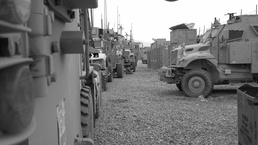
Members of the 45th Infantry Brigade Combat Team accomplished the mission with a diverse team effort. The 700th Brigade Support Battalion joined forces with soldiers from Company A, 45th Brigade Special Troops Battalion, Route Clearance Package, 1st Battalion 179th Infantry and members of the 1st Brigade, 201st Corps, Afghan National Army, Nov. 19, to become the largest convoy that has ever been down Route Iowa in Laghman province.
The mission was recover vehicles located at Kalagush. The 700th BSB coordinated the convoy and provided nearly 70 personnel for the endeavor. More than a dozen ANA soldiers supported the mission as well. The convoy of more than 20 vehicles moved along the route at a grueling snail’s pace eventually covering more than 300 miles.
In the past, Route Iowa was known for its history of being riddled with improvised explosive devices. Coalition forces and the ANA have made a strong presence in the area making the route safer for travel.
“We really didn’t know what to expect, but basically you move anywhere from probably two to five miles per hour, so just to move a short distance it will take you hours,” said U.S. Army 1st Lt. Derek Lachance of Noble, Okla., 2nd platoon, Company A, 700th BSB platoon leader. “That was the first time we ever rolled in a route clearance package. They found IEDs that could’ve eventually hurt people.”
The RCP cleared the way for the convoy using vehicles like the Husky, which has ground penetrating radar, providing the ability to detect explosive devices before the rest of the convoy approaches.
The trip through Laghman province took days because of the sheer size of the convoy and the snails pace at which the RCP must move.
Dismounted ANA provided valuable assets to the convoy as they spotted and eliminate IEDs. The ANA continue to demonstrate their ability to conduct operations and protect the citizens of Afghanistan.
“They partnered as dismounts with us,” said U.S. Army Capt. Marion Mason of Geronimo, Okla., and commander of Company A, 700th BSB. “It also helps the local populace see their own Army out there working along with us and it contributes to COIN (counter insurgency) and it also shows them that eventually they are going to be ready to take over and allow us to pull out of the country.”
There are always risks of IEDs when travelling on dangerous routes, this particular time was no exception. The RCP was prepared to find and eliminate IEDs.
Many IEDs were successfully spotted by the RCP, but there were two instances of small IED engagements.
“I heard a boom, I saw dust go thirty feet into the air, that’s when they called out IED,” reported Lachance.
There were no injuries to personnel during this convoy.
Everyone involved worked tirelessly to ensure mission success. Teamwork was essential to planning and executing a convoy of this size in a relatively dangerous area.
“It enabled us to identify what excess property was up in Kalagush, we were able to step up and assist our (TF) Ponca brothers as far as getting that excess equipment out of there, allowing them to go ahead and continue on with their mission,” said Lt. Col. Douglas Gragert of Choctaw, Okla., 700th BSB battalion commander. “It showed that Alpha Company, along with other companies within the battalion were able to pull together as a team and accomplish the biggest convoy that was ever taken down RT Iowa.”