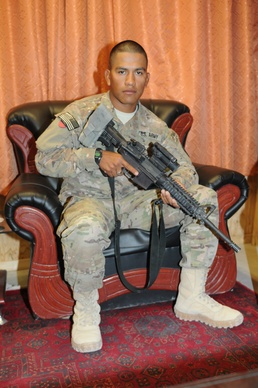
FORWARD OPERATING BASE SPIN BOLDAK, Afghanistan – If parents and teachers worried about how children might fare in the months following the Sept. 11, 2001 attacks, they no longer need to worry. Some of the children who were in elementary and junior high schools a decade ago have grown up to be soldiers and are contributing to the rebuilding of a nation that a decade ago they couldn’t locate on a map.
According to the Department of Defense, more than 100,000 service members are currently deployed to Afghanistan in support of Operation Enduring Freedom, 47.3 percent of those are soldiers ages 17-24, making the age demographic the largest group of service women and men contributing to the effort of eliminating the presence of terrorist networks and empowering the Government of the Islamic Republic of Afghanistan. Here in southern Kandahar, those soldiers participate in the fight in both combat and non-combat roles as part of the 504th Battlefield Surveillance Brigade from Fort Hood, Texas.
Ten years old when he first witnessed the planes flying into the Twin Towers and the massive blocks of steel collapsing, Pfc. Lance A. Thibodeaux is now an infantryman and member of the personal security detail team for the 504th BfsB here. Although he saw the events live on television, Thibodeaux said as a 10-year-old, he struggled to grasp the impact of the events or how they would change his life.
“I was about to go to school and saw the live footage,” said Thibodeaux, who at the time was attending a Catholic school in Vista, Calif. “It just didn’t register. I didn’t know where the World Trade Center was.
“As a ten-year-old, my life consisted of school, video games and sports,” Thibodeaux said. “I knew of Afghanistan, but I was oblivious of what was going on there.”
For Thibodeaux and students his age, an education on Afghanistan and terrorist networks, Islam and international diplomacy, would be a crash course. In the months following the attacks, Thibodeaux and his classmates were introduced to a region of the world they had barely heard of, and a religion they didn’t know much about. They were also introduced to, from television commentators and the snippets of news children are exposed to, a terrorist network called the Taliban which impacted their young lives more than any monsters bore from the vivid imaginations of young children could have.
Thibodeaux also noticed the slight, subtle differences in his life. At first, there was the terrorist alert chart – the multi-colored codes that reminded the children and the adults in their lives of the constant threats of terrorism. Then, there were the long lines at the airport. Having flown prior to Sept. 11, Thibodeaux said the change stood out to him.
“It used to be that we could go all the way up to the gate to say goodbye,” he said. “Now, they had to stop us at security.”
Spc. Alisa Davis also noticed the difference. As an 11-year-old, in sixth-grade in Columbia, S.C., Davis first heard of the attacks at school and immediately noticed the difference. Like many other children her age, Davis also had her life subtly changed.
“I was confused,” Davis, a radio communications specialist with the 509th Forward Support Company, said. “You weren’t supposed to see planes fly into buildings.”
Later that night, still unaware of the seriousness of the event, the young Davis turned on MTV – the music television channel she said played a central part in her life, only to find more coverage of the event.
“What 11-year-old wants to see the news?” she said. “So I turned on MTV, but all the channels were showing it.”
The next day and in the following months, Davis noticed more changes – both in school and on Fort Jackson, the Army Basic Training base where her father worked.
“Our workload changed,” she said. “The next day, it was more talking to the teachers and guidance counselors.”
Then there was the controlled access she’d never been used to. As a little girl, Davis was free to get on and off the base that would later serve as her basic training site. Yet, on the days and months after the attacks, access on the base became much harder to come by. Despite these changes, Davis said she didn’t understand the bigger impact of how her life would change.
“As an 11-year-old, I just heard snippets of what was going on, but didn’t discuss much of it,” she said. “It wasn’t until I got to high school that it became real.
“Back then, I was still concerned with having sleepovers,” she continued.
Pvt. Fernando Sosa, an information technology specialist, was most certainly in trouble the day of the attacks. In just third grade in San Juan, Texas, Sosa was in detention when he first saw the events unfold on a school television.
“I was grounded that day,” the 19-year-old said. “So the instructor turned on the TV and I was in shock – as a third grader, you just don’t realize what was going on – what was happening.”
Like both Davis and Thibodeaux, Sosa was also unaware of the on-going events around the world, and the various players and organizations that would become buzzwords and the center of their lives for the next decade.
“I was just living a kid’s life,” Sosa said. “I didn’t know what the military was doing – sort of like now how people don’t know what we’re going through.”
Yet, a decade later, through the rites-of-passage of adulthood and for various reasons, all three find themselves in the middle of a war zone, facing enemies and fighting a war that, when it first started, was mere child’s play to them.
“It’s different, I just can’t wrap my mind around it,” Thibodeaux said. “I’ve always wanted to be a soldier in the infantry – I just fell in love with the romance of it all – the flash and the bang-bang. But it’s eye-opening – it shows how big and how small the world is at the same time.”
It is that realization that they are not alone and the sheltered life as children won’t always be there for them, that drives Thibodeaux in his work. As part of the security details, his responsibility includes transporting top leaders to and from various bases, and when they are there, serving as part of the dismounted security team. At times, he also serves as the gunner – the person on top of tactical vehicles, constantly scanning the road for signs of improvised explosive devices and enemies hiding in the desert.
During those trips, despite his keeping a vigilant watch on the enemy and tactics they employ, Thibodeaux also takes in the living conditions and plight of the Afghans whose country he hopes to help build.
“I see the minefields – the massive minefields,” he said, waving his hand to emphasize the size of the cordoned-off areas in Afghanistan locals have grown accustomed to. “I hope we can help them in a more effective manner and provide them with the basic necessities like electricity and running water.”
Then, there are the children, some the same ages as Thibodeaux and his comrades ten years ago – children who, since they were born, have known nothing but was and the threats of being dismembered or killed for simply being children playing.
“Some of these children who are 10 or 11 now, it’s not like they have a choice – all they’ve known is war,” he said. “They’re being told to stay away from this place or that place because it’s dangerous. We’re not used to it, but they live it every day.”
In these children, Thibodeaux places his hope – hope that as they grow up, and as the Taliban’s presence diminishes in Afghanistan, they will get to live in a world and nation without the violence already common place in their lives.
“When the older generation is no longer teaching younger generation … so much violence, when there’s no more terrorism, that’s when the U.S. leaves,” Thibodeaux said. “Maybe it can provide them a flicker of hope that they can have luxury and a sense of security without the violence.”
But being altruistic and hoping the best for Afghanistan’s future doesn’t exclude the young soldier and those his age from worrying about themselves. They, too, have a need for a security and especially at a young age, sometimes long for the people who, through that infamous September day and in their journey toward adulthood, have protected and sheltered them from the ugliness they now face.
“My goal here is to also stay as safe as possible,” Thibodeaux said. “All I can do is what I am told and if at the end of the day, it makes their lives better, then good. And if I can come back safely, it’s even better.”
Like Thibodeaux, while Sosa spends the majority of his days concentrating on his job, and even with the understanding that his job of providing both classified and unclassified communications tools affects the overall mission in Afghanistan, for a 19-year-old, sometimes being away from family is too much to bear.
“I just got out of high school, so this is an adventure for me,” he said. “But not being able to communicate with my mom or my sister face-to-face, and having grown up with that, it’s just hard. It was hard telling my family I was leaving. My sister took it the hardest.”
Even harder for Sosa, who joined the Army less than a year ago and spent most of that time training before deploying, is understanding the overall mission in Afghanistan. Though he has had limited interactions with local Afghans, Sosa said his understanding of the big end state is still elementary.
“I’ve spoken with these local nationals, and they’re not bad people,” he said.
More seasoned and having a bigger understand of the military’s end state in Afghanistan, Thibodeaux said he wishes to see progress made in Afghanistan, other than the daily things he’s seeing from his vantage point.
“It would be nice,” he said. “It’s hard to see how the cogs and wheels turn from my little world. I only get a little snippet of it from my area of operations.”
Despite that lack of understand, the soldiers say they are committed to winning the war, some for emotional reasons, while others simply they are able to help out.
“It angers me,” Thibodeaux said of the attacks. “Back then, I didn’t have a grasp on the reality of the situation, but as I grew up, it was like a slap in the face.”
While Thibodeaux’s commitment to OEF is based on his emotional ties, other soldiers say they are committed to their jobs because of the expectations thankful civilians have of them.
“I remember being at the airport in uniform and people thanked me like I’d done something special for my country,” Sosa said. “I hadn’t done anything to deserve it. But now that I am here, it’s different. I am out here doing something for these people and it feels good.
“It’s not like we’re asking to be out here, but it’s our job – someone’s got to do it,” he continued.
Yet, despite the bravado and courage displayed, Sosa, much like other soldiers, also hopes to quickly rebuild the war-torn nation, allow Afghans to take the lead in protecting their own sovereignty and return home to the people who loved and worried about him prior to and after the Sept. 11 attacks.
“I just hope this thing ends quickly,” he said. “No one wants their loved ones out here. No matter how old you are, you still run the risk of getting shot.”