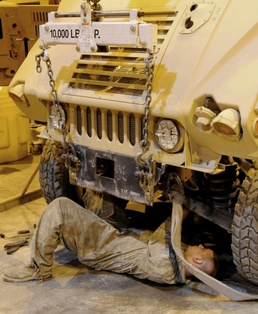
SALAH AD DIN, Iraq - While the drawdown is in progress, there are about 1,000 vehicles still on Joint Base Balad, Iraq, that all require maintenance.
The 332nd Expeditionary Logistics Readiness Squadron Vehicle Maintenance flight supports the flying and security missions, while also keeping the people moving at JBB, by keeping anything on wheels operational.
The flight is broken down into three sections: up-armored vehicles such as humvees and mine resistant ambush protected vehicles, general purpose vehicles and vehicles for the flight line such as forklifts.
“The most common issues we see are broken air conditioners, needing new brakes and flat tires,” said Master Sgt. George Pardee, 332nd ELRS Vehicle Maintenance Force Protection shop superintendent.
The maintainers work 24-hours a day, seven-days a week, but the time it takes to fix a vehicles depends on what the issue is.
“Vehicles are categorized into priorities, with the average vehicle taking two-six weeks to be fixed,” said Pardee, who is deployed from Hancock Field Air National Guard Base, N.Y. “It also depends on how we will procure the parts; we have a supply system, but most of our parts come from NEI, a contracted service.”
Working alongside the maintainers on general purpose vehicles are 23 local Iraqi citizens.
“About two years ago we started a local mentorship program under the [Air Force Contract Augmentation Program] that trained them and now they are the backbone of our shop,” said Tim Gilpin, Sallyport contractor, who is originally from Wasilla, Alaska. “They have all learned a lot and bettered themselves and it’s great coming to work with them every day.”
The maintainers’ job looks very physical to most, but there is a technical aspect.
“I don’t think the maintainers always get credit for the technical experts they have to be for the vehicles,” said Pardee, who is originally from Central Square, N.Y. “Technology moves fast on vehicles and most vehicles have at least three different computers that we have to work with.”
To help maintain the vehicles, all vehicles are inspected annually for safety and the vehicles undergo a full-service inspection every 18 months.
“In preparation for the drawdown, we are performing all inspections that need to be done now through December right now we so are keeping very busy,” said Pardee. “We have to keep all the vehicles safe and serviceable. Those that are going to be forward deployed have to be mission capable and be able to go 60 days without any sustainment.”
It may not be an easy job, but there is a tangible end result.
“The best part of this job is the satisfaction you get from fixing a vehicle, not every job gets to see an end product, but we do when the vehicle is fixed and runs,” said Pardee. “We even find better ways of fixing things that are faster and more efficient.”