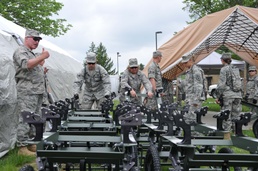
MUSCATATUCK URBAN TRAINING CENTER, Ind. - When Army Guard soldiers said to “drop the trailer,” the Air Guard members moved to disconnect the trailers from their vehicles instead of simply dropping the ramp on the trailer.
Indiana Air National Guard Lt. Col. Lisa Snyder cited this confused beginning to the first joint training exercise for Indiana’s emergency response unit as just one example of why the exercise was so important.
“Even the small nuances” can make a big difference, said Snyder, a doctor with the 181st Intelligence Wing and commander of the medical element, which combined 51 Air Guard members from the 181st Intelligence Wing, from Terre Haute, Ind., and 122nd Fighter Wing, Fort Wayne, Ind., for the May 14 exercise at the Muscatatuck Urban Training Center near Butlerville, Ind.
“This has been just an excellent experience,” Snyder said.
Army and Air Guard service members began communicating, and through halting first steps, a CERFP location took shape, and the tents and equipment were organized to handle mass casualties. Besides the medical element, there were 74 soldiers from the 438th Chemical Company and another 63 from the 1313th Engineers. They’ve been practicing on their own, but this was their first opportunity to train as a complete emergency response unit.
Their training scenario involved an earthquake that destroyed a building housing a civilian laboratory with dangerous biological agents like ricin. There were 150 people missing with 110 of them believed to be in the lab. Engineers would extract survivors, who would be decontaminated prior to receiving the medical care necessary before transport to a hospital.
The size of the disaster was too great for first responders, making it a classic scenario for the emergency response unit, commanded by Lt. Col. Eric Vonhoven of the 81st Troop Command, which has responsibility for the mission.
Indiana Army National Guard Brig. Gen. Corey Carr, commander of the 81st, was also on hand.
“This all gets them ready for validation in August,” Carr said.
If the real thing occurs, Carr will assume the unique role of “dual command,” which puts him in charge of any federal troops that may be called in. Carr said Hurricane Katrina showed the need for a unified effort in times of disasters, and there began a push to unify response efforts under the state’s National Guard.
Illinois also has an emergency response unit. The Illinois Guard has already gone through validation. The Illinois soldiers and airmen came to the MUTC event to provide guidance.
“We’ve been through it, so hopefully you won’t get as many cuts and bruises,” said Lt. Col. George Vukotich, commander of the Illinois medical element, who noted that Indiana Guardsmen face a unique challenge.
“One of the big things is a shorter time period,” Vukotich said. “You’re on an accelerated process.”
There’s a lot to do, besides developing a joint terminology, Vukotich said, the Indiana Guardsmen must come up with a common system to track patients, learn their new equipment, and work as teams to quickly set up tents.
In the scenario, victims left the decontamination tents and proceeded into the medical tents. There are separate treatment lines for male and female victims. Unconscious victims are conveyed along on rollers.
Indiana Army National Guard Capt. Brandon Holloway, commander of the 438th Chemical Company used a cell phone to time his troops. During the real thing, Holloway would move between the disaster site and the operations center. As a result, 1st Lt. Jason Moore and Sgt. 1st Class Hugh Robertson were in charge of the decontamination effort.
“I think that morale is high,” Holloway said. “The soldiers know their jobs.”
The engineers were also motivated.
“We love it,” said 1st Lt. Stanly Kersys. “Everybody’s excited about it.”
Their job is search and extraction. They do breaking and breaching, rope work, and shore up areas so their comrades can safely rescue people. They also perform the initial reconnaissance, and as such, the engineers spearhead the effort.
“Our recon team will be the first ones on the scene,” Kersys said.
Besides the Army soldiers, the Indiana air guard enjoyed working with their counterpart.
“It’s a learning experience” said Indiana Air National Guard Staff Sgt. Shannon Brown, regarding working with Army soldiers.
Her fellow Army troops agreed.
“I love it, [the Air Guard] works differently but everyone is working together as one big team,” said Indiana Army National Guard Sgt. Mallory Wilson, a 738th Area Support Medical Company medic from South Bend, Ind.
“It’s exciting to be part of something new and building something from the ground up,” said Brown, a bio-environmental engineer from Indianapolis.
Regardless of military backgrounds the troops enjoyed being a part of something new and a mission that helps Hoosiers throughout the state.