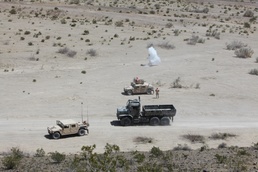
MARINE AIR GROUND COMBAT CENTER TWENTYNINE PALMS, Ca¬lif. – “We have sight of a possible IED,” said the Marine through radio traffic. “Where is your position?” his comrade replied.
Marines and sailors with Combat Logis¬tics Battalion 1, Combat Logistics Regiment 1, 1st Marine Logistics Group, participated in a Motorized Operations Course, here, April 15, to get realistic training of how combat logistics patrols are conducted while deployed.
The Motorized Operations Course is a training operation, which features three scenarios Marines may encounter while de¬ployed to a combat environment.
The course began with the Marines and sailors conducting a combat logistics patrol and spotting a possible improvised explosive device. The combat logistics patrol came to a halt, after locating the IED, the Explosive Ordnance Disposal team performed a con-trolled detonation and the combat logistics patrol pushed forward.
“This training really keeps you on your toes,” said Lance Cpl. Shawn Fitzgerald¬adams, motor transport operator, Charlie Company, 3rd Assault Amphibian Battalion, attached to CLB-1, CLR-1, 1st MLG.
As the patrol pushed forward, the Ma¬rines heard a loud boom! A simulated mor¬tar from an enemy bunker position exploded close to the road. The security vehicles sprang into action and provided return fire so the rest of the combat logistics patrol could safely pass through.
“The live fire [portion] was very real¬istic,” said Fitzgeraldadams. “The security vehicles had to get in position to suppress the enemy while the rest went through safely.”
After the convoy made it past enemy fire, another loud boom was heard and a giant dust cloud filled the air. One of the vehicles struck a notional IED and suffered ‘casualties.’ The rest of the convoy stepped in to provide security, assess the casualties, set up a landing zone and call the IED strike over the radio. After everything was completed, the patrol conducted a vehicle recovery mis¬sion to finish up the training.
“It’s very good training for us,” said Lance Cpl. Michael Gant, Motor Transport Operator, Motor Transport Company, CLB-1, CLR-1, 1st MLG. “Since I’m an operator, I have to drive on a regular basis while deployed. Going through this gives me a better understanding on what to do in those situations.”
CLB-1 is making sure their Marines and sailors are ready for whatever situation they may face so they are able to complete the mission and return safely.