FORT HOOD, Texas – The task is monumental. In fact, it’s a job so big that giant Air Force C-17 and C-5 strategic airlift aircraft are involved.
Even lumbering Antonov An-124 heavy lift cargo planes are in on the action.
Before the 40th Combat Aviation Brigade begins its yearlong mission in Iraq, it first must get over there. That means more than 2,000 soldiers, dozens of helicopters and tons of equipment must be transported by land, sea and air from Fort Hood, Texas, to the other side of the planet.
“It’s huge,” Chief Warrant Officer Amanda Fisher said of the scale of movement. Fisher is the brigade’s mobility warrant officer and is in charge of organizing and overseeing the brigade’s movement operations.
“The challenge is that there are so many elements,” she said.
The CAB’s battalions and its higher headquarters company wrap up two months of intense pre-deployment training at Fort Hood at the end of January. The units have conducted all manner of aviation and soldier skills training, as well as two training exercises that simulated various scenarios expected to be encountered in Iraq, with both exercises running a week in length. At the same time, a complex logistical operation has been underway.
While participating in such pre-deployment training as convoy operations and helicopter mounted gunnery, the brigade’s unit movement officers have worked overtime to document, palletize, load up and ship out a vast amount of military hardware.
The shipment of some of the CAB’s helicopters and equipment began in late December. Advance parties departed for Kuwait in mid-January. Once pre-deployment training finishes at the end of the month, the 40th CAB’s main body will be on the move.
Adding to the complexity of the movement has been the number of aircraft involved, Fisher explained. Personnel are departing on chartered airplanes, while the brigade’s helicopters and containers full of equipment are being transported on C-17 and C-5 strategic airlift aircraft.
In addition, five An-124s—aircraft larger than the Air Force’s biggest, the C-5—were contracted out from Russian companies.
Also, two ships loaded down with helicopters and containers departed from Beaumont, Texas in late December.
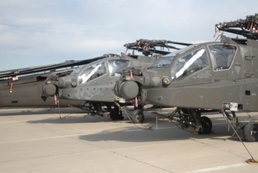
The brigade’s UH-60 Black Hawk, CH-47 Chinook, OH-58 Kiowa and AH-64 Apache helicopters were broken down before being loaded onto the planes and ships. They are being rebuilt as they arrive in Kuwait before being flown into Iraq.
“It’s challenging getting everyone on the same page and having to work all the different parts,” said Sgt. Nathan Fielding, the 40th CAB’s non-commissioned officer in charge of unit movement operations. Fielding coordinates with the unit movement officers in the CAB’s battalions down to the company level.
“It’s a very big deal—all these moving parts that are involved in projecting that combat power,” said Lt. Col. Mark Kampa, who heads the brigade’s logistics office. “We have to get everything there—people, parts, containers, trucks, weapons, helicopters. It’s an incredibly complex job that requires all the brigade’s personnel.”
The 40th CAB is made up of aviation units from the National Guard, Army Reserve and active-duty Army, with elements from 22 states. The brigade is headed by a California Army National Guard headquarters company from Fresno, Calif.
The 40th CAB is taking over the mission in Iraq from the Kansas-based 1st Combat Aviation Brigade, which is nearing the end of its yearlong deployment. The 40th CAB will be responsible for full-spectrum aviation operations in Iraq for the remainder of 2011, to include everything from medevac to reconnaissance to force protection.