Story by: 1st Lt. Mark Verburg
CAMP BASRAH, Iraq – Last September combat operations in Iraq officially ceased, but for the combat engineers assigned to Exile Company, whose mission is to protect the force, nothing has changed.
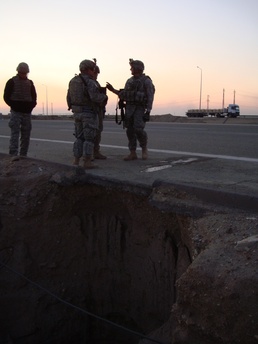
Although the combat mission is complete, combat engineers, or sappers, of Company E, 1st Battalion, 68th Armor Regiment, 3rd Advise and Assist Brigade, 4th Infantry Division, perform route clearance operations throughout Basrah province, providing safe mobility for U.S. and Iraqi forces.
“Exile Company provides freedom of maneuver and protection to the force. We do this by clearing IED's, obstacles, and terrain that U.S. and Iraqi forces maneuver on so they are able to conduct security and partnership operations,” said Capt. Greg Polk, of Cincinnati, commander, Company E.
Company E’s two platoons provide route clearance for the entire southeast corner of Iraq, regularly clearing 600 miles of roadway spanning a 7,000-square-mile area in support of Operation New Dawn.
Each route clearance element has taken on a larger land area as a result of the drawdown of U.S. forces in Iraq. More area to cover has required a fundamentally different approach to clearance, one focused on managing mission times to cover as much key terrain as possible.
Staff Sgt. Jesus Zambrano, squad leader, 3rd Platoon, is currently on his third tour in Iraq, and he sees the difference in route clearance operations this time compared to past deployments.
“Last tour we cleared only 80 or 90 kilometers per mission at 20 kilometers per hour. That gave us maximum time to observe possible threats,” said Zambrano, a native of Del Rio, Texas. But he said that having greater area to cover forces route clearance teams to work smarter and more efficiently, maximizing the assets and information available to them.
Route clearance planners lean heavily on company intelligence support teams for crucial input into the route planning process. Keeping bomb emplacers off-balance in a 7,000-square-mile area is a tall order.
Intelligence assets help bring precision in getting the route clearance patrols to the right place at the right time to deter IED emplacers or find IED's before maneuver patrols can be targeted.
“We use all intelligence, indicators, and historical data available to predict and target when and where we should be on the battlefield to conduct our operations,” said Polk.
Exile Company looks to Staff Sgt. Joseph Carpenter of Thornton, Colo., and Sgt. Patrick Kohls of Colorado Springs, Colo., for intelligence support. The two collect and analyze IED data and brief each Exile Company patrol on the most current information before they execute their mission.
Company E’s approach has proven effective in the unit’s area of operations. Total IED's per month since October have averaged just over three, compared to an average of nearly six per month earlier in the tour.
By pushing the enemy out of familiar areas, Exile Company has assisted Iraqi security forces in detecting possible attacks and decreased the lethality of attacks that do happen.
“Insurgencies rely on striking the larger force where it is vulnerable and when it is unexpected. Our route clearance operations minimize those opportunities,” said 1st Lt. Matt Fumagalli of Westmont, Ill., platoon leader.
Measurable success is encouraging to soldiers, but as the drawdown continues, keeping roads clear of IED's becomes more and more challenging. Exile Company is committed to meeting that challenge.
“All missions in a combat environment will carry a certain amount of risk. It is our job to mitigate it and do everything we can to lower the odds for our side,” said Polk. “The last IED in this conflict will receive no less attention than any other in my eyes.”