By Cpl. Daniel Eddy
BAGHDAD - Redeployment. It is a beautiful word for soldiers who have spent nearly a year overseas. As the day approaches, thoughts of home begin to be more prevalent; soon they will homeward bound.
One step in the redeployment process is ensuring containers and CONEX are loaded with materials and equipment, placed on a truck, and then shipped back to the unit’s home station, via truck, rail, air or sea.
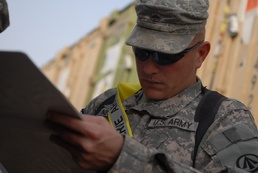
The day the trucks are loaded, the Deployment and Distribution Support Team – Center sends two soldiers to meet the convoy at the gate and escort the convoy until it is ready to leave. These soldiers help verify every container, CONEX and vehicle that is suppose to be loaded.
The amount of work observed by an outsider on the day of the container pick up, is like an iceberg in the water, displaying only a fraction of its true mass.
The DDST starts planning redeployment for large units far in advance of the date they leave, making sure the process goes smoothly.
“We go out and give a redeployment brief to units when they are about 180 days [away from] going home,” said Capt. Alvaro Ramirez, officer-in-charge of the DDST-C with 840th Transportation Battalion and a Milwaukee, Wisc., native. “Our process is fairly smooth; we have built it into a timeline. We have certain milestones we have to meet, and if we stick with our timelines, it makes for a less stressful environment.”
This seven-man unit plans in advance, because of the many different tasks they have to complete.
One critical part of the team’s job is to provide a briefing to redeploying units, so they have necessary details about U.S. customs procedures.
Master Sgt. Swane Blackmore, non-commissioned officer-in-charge of DDST-C with 840th Trans. Bn., and a New Orleans native, said it’s better to provide units the correct requirements before they get started in the planning, than for them do it wrong and have to correct it. Blackmore said the briefings are beneficial because units get a good point of contact for many redeployment issues.
The DDST also works on a unit movement plan so the redeploying soldiers do not have to worry about their cargo until it reaches their home station, Blackmore said.
“The bulk of the plans we do is what we call [the] door-to-door process,” Ramirez said. “We work with the unit to get their equipment shipped from duty location in Iraq, all the way to their duty location stateside.”
Blackmore said years ago, commanders had to send 20-30 Soldiers down to the port in Kuwait in case any issues with the cargo would arise. Soldiers sent down to the port would not be able to go home until the vessel was loaded. But with the door-to-door process, the need to have soldiers travel down to there is eliminated.
Then comes the time for the cargo to leave the base and start the door-to-door process.
Blackmore said, typically, the soldiers will conduct a final cross-checking process, prior to loading, about a day or two in advance. That way, if any problems are identified, units will have 24 hours to correct it, before the trucks arrive.
He said one thing the soldiers make sure of is that there is not any hazardous material mixed in with the regular cargo, because that can slow cargo processing, bottlenecking cargo at the port.
The mission of the DDST-C is to support USD-C and all the units under its command. Since there are bases throughout the Baghdad area, the DDST-C does not stay confined to one base, but will travel to different bases ensuring units’ cargo is loaded correctly.
Ramirez said they will send out teams of two soldiers to different bases for the briefings and once more when the cargo is loaded onto the trucks.
Blackmore said the average team might be gone for a day or two if all goes according to plan. Primarily, they like to have the team out to the base a day before pick up, so in case there is a problem, they can fix it the day before the trucks and all moving assets arrive.
Blackmore said he enjoys sending soldiers home and when it comes time to help units, they are eager to help.
“It’s a good feeling [sending soldiers hom],” he said, “because a soldier’s job is difficult and … these guys love to see the trucks coming. So as far anything you need, you don’t get any hassle, because we are the ones sending them home.”