Pop, pop, pop!
The sound of gunfire cracks the air. Airmen scramble – chairs, desks, and furniture are tossed to barricade an entrance. Now fortified, they wait ...
Outside, two Airmen tackle the active shooter, throw him to the ground and detain him.
“You have to be able to hold your composure,” said Maj. Desmond Awadzi, the deputy director of contracting for the Department of the Air Force Portfolio Acquisition Executive for Command, Control, Communications and Battle Management. “Gunshots are going off around you, people are trying to enter your tent without authorization, and all the while, you still must execute what you’re supposed to do for the warfighter.
“That’s the moment the lightbulb goes off for trainees. They realize, ‘This can happen to me when I deploy.’”
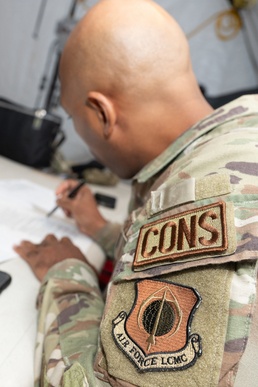
Air Force contracting specialists face real threats while forward deployed, ranging from hostile combatants to dubious vendors. Considering that reality, Airmen from across Hanscom Air Force Base, Mass., recently completed an intensive five-day contingency contracting officer exercise designed to prepare them for these potential threats at Camp Patriot, here.
“People sometimes view contracting as purely an administrative function, but in a contingency environment, it’s at the very core of providing capabilities for the warfighter,” Awadzi said. “You’re sitting in the room as an operational business advisor to commanders, helping them navigate complex requirements, and then going out into an austere environment to procure and manage what they need to survive and win.”
The training is an annual requirement under Department of the Air Force Instruction 64-105, Contingency Contracting Support, for Airmen holding contracting Air Force Specialty Codes: officers (64P) and enlisted contract specialists (6C0X1). Throughout the week, trainees faced a plethora of realistic training injects, from active-shooter incursions and unauthorized tent breaches to unvetted vendors peddling unneeded supplies.
“As military contracting officers, we are responsible for the ‘away game,’ while our civilian counterparts manage the ‘home game,’” said Capt. Brianna Johndrow, the lead architect of the exercise and a contracting officer with the Cyber and Networks Directorate. “We wanted folks to get away from the comfort of their stateside offices and experience what they might encounter downrange, not just from a contracting aspect, but with the actual real-world combat stress.”
Airmen in these roles work to bridge the gap between military commanders and the commercial sector. Contingency contracting officers and specialists embed directly into combatant commands and joint environments to plan, procure, and manage critical life-support supplies, services, and base infrastructure from local commercial sources.
“In the planning phase, you are sitting in rooms with leaders and requiring owners, and you need to be the advisor helping them know what they can do, how they can do it, and the capabilities we have on hand,” Awadzi said. “When it comes to procurement, that becomes your wheelhouse to go out and procure what the need is, and after procurement, you manage that contract to ensure what they wanted has been provided. It’s a whole lifecycle.”
These Airmen navigate local laws, cultural nuances, and complex international supply chains. They often work under physical threat and extreme time pressure to ensure combat forces possess the assets and facilities required to sustain mission operations.
“Ninety percent of our trainees have at least four years of contracting experience, so they know how to do the job,” Johndrow said. “Our vision is to continue challenging them to grow into strategic planners who can wear different hats. When they’re faced with a complex problem set while deployed, they can look back at this exercise and say, ‘We trained to that. Let me pull it from my toolbox and apply it here.’”