First Day Delivery
An Emergency Medical Technician’s first call can be anything, from a minor paper cut to a missing limb. Fortunately, new EMTs can almost always look towards their more experienced supervisors when responding to a serious emergency. But this raises the question: what happens when your first call is something that not even your supervisor has experienced?
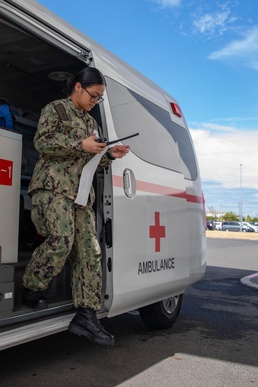
U.S. Navy Hospital Corpsman Feverlynn Luis, assigned to Naval Family Branch Clinic Iwakuni, and a native of Rota, North Mariana Islands, had just completed her EMT course at the Naval Family Branch Clinic. This course is designed to teach Naval Corpsmen about the scope and practices of EMTs which can differ from traditional patient care in many ways. The course is conducted at an accelerated pace and students are expected to study nightly. Passing every test meant that Luis qualified and earned her certification as an EMT. However, attaining the certificate doesn’t necessarily mean that an EMT will be properly prepared for the stress of responding to real world emergencies, a stark contrast that Luis would soon face, head on.
After six months of Corpsman school, two months of EMT training, and four months of active patient care, Luis was finally ready for her first day as a practicing EMT at Marine Corps Air Station Iwakuni. Although the principles of patient care may remain the same the resources available to EMTs proved to be a challenge of its own.
“It was my first day, so I was a little nervous,” said Luis.
Shortly after changing over with the previous shift of EMTs, a call came in — somewhere on MCAS Iwakuni, a woman was going into labor. Immediately Luis and her supervisor, HM3 Dawn Perry, assigned to Naval Family Branch Clinic Iwakuni, and a native of Elmira, New York, responded to the call. They arrived on scene at a two-story town home. Luis grabbed clean towels, just as she had been trained and rushed inside, through the door and up the narrow staircase.Between the Officers and MCAS Iwakuni Fire and Emergency Services members, the small bedroom was packed with nearly 20 people. As Luis made her way through the crowded room, she came face to face with her patient and a situation that would challenge everything she had learned.
The job of an EMT is primarily addressing immediate life threats and transporting patients to the nearest appropriate medical facility. When assessing any situation EMTs need to be able to decide if the situation necessitates “load and go” or “stay and play.”EMTs use these two phrases when describing a situation where they must choose when to treat a patient on scene versus immediately transporting them to an appropriate medical facility. As Luis came into the room, she saw a pregnant woman lying on the bed, actively in labor.
“The baby's head was crowning,” said Luis. “At that point we couldn’t move her from her bed all the way to the ambulance to transport her.”
Luis had learned that when responding to a pregnant woman experiencing contractions, there is almost always enough time to transport them to a birthing clinic. Many EMTs can go their whole careers without ever delivering a single child, however Luis would have to do so are her first call.Luis immediately got into position to support the baby’s head upon delivery. As soon as Perry, the senior EMT, stepped into the room, the head came out.
“That’s when we noticed that the cord was around the baby’s neck,” said Luis.
While the umbilical cord being wrapped around the baby’s neck isn’t rare during birth, it is always concerning. The umbilical cord could cut off blood flow and breathing if it’s wrapped tightly. After calling the Medical Officer of the Day, a licensed military physician, and requesting further instructions, Perry and Luis tried to move the umbilical cord away from the baby’s neck, but to no avail. Luis did the next best thing and continued supporting the baby’s head while holding the cord, trying to relieve pressure.
“HM3 Perry was with the mom, encouraging her to push,” said Luis. “After two minutes or so, the baby was fully out.”
Malakai was born at 9:03 AM on Monday, August 3rd, weighing 7 pounds and 8 ounces. After delivery, Perry was able to remove the cord from around the baby’s neck, then wrapped the baby in clean towels, and handed him to his mother. Shortly after, Luis and her supervisor transported both the mother and child to Iwakuni Branch Health Clinic to receive further care. During a subsequent checkup Luis and Perry had the opportunity to speak to the mother in a calmer setting.
“I really appreciate what they did on that day” said Malakai’s mother, “I find it amazing that all of them will be a part of a very crazy birth story that will be told for a lifetime”
By the end of her first shift, Luis had successfully responded to an intense and stressful call. What began with nerves and uncertainty ended with the safe delivery of a child into their mother’s arms; and an experience that would stick with Luis for the rest of her career.