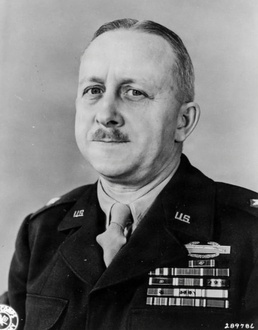
On Sept. 26, 1918, Sgt. Cecil B. Whitcomb, attached to the intelligence section of the 145th Infantry Regiment, 37th Infantry Division, earned his first Distinguished Service Cross for heroism during the opening phase of the Meuse-Argonne Offensive. He would earn his second award twenty-seven years later during the Battle of Manila.
In 1917, 18-year-old Cecil B. Whitcomb joined the Ohio National Guard and was assigned to the 5th Ohio Infantry Regiment. As the U.S. Army prepared to deploy for World War I in the fall of 1917, the Ohio National Guard was reorganized for federal service as the 37th “Buckeye” Division, and the 5th Ohio Infantry was renumbered the 145th Infantry. Whitcomb deployed with the division to France in June 1918. In mid-July, the unit was ordered to the front and tasked with holding the Baccarat Sector in the Vosges Mountains in eastern France, where they underwent training under fire in the leadup to the offensive that would end the war. They were relieved in mid-September and moved northwest toward Montfaucon for the opening phase of the Meuse-Argonne Offensive on Sept. 26, 1918.
The 37th Division was tasked with clearing the wooded area around Montfaucon with the objective of capturing the town the first day. The teenaged Sergeant Whitcomb joined the 145th Infantry’s intelligence section in the first attacking wave, but the unit quickly fell under heavy machinegun fire that prevented them from advancing far. Whitcomb bravely left the safety of his unit to reconnoiter the location of the enemy gun emplacements and managed to capture several unarmed enemy soldiers and an officer. Having discovered the German machinegun nest covering a nearby bridge, he forced the captured officer “to deliver to [Whitcomb] the gun crews, a number of men, as well as several enemy snipers,” ending the barrage of gunfire and allowing the regiment to continue without further heavy casualties. The Buckeye Division ultimately failed to clear Montfaucon that first day, but Whitcomb’s boldness and courage earned him his first Distinguished Service Cross.
Following the war, Whitcomb rejoined the Ohio National Guard and was commissioned an officer in 1922. When the guard was recalled for federal service during World War II, he was serving as a battalion commander in the 145th Infantry. In 1943, then Col. Whitcomb found himself in the Solomon Islands, where he took command of the regiment and led it through the Bougainville Campaign. He was still in command when the 37th Division landed on Luzon in January 1945.
While fighting to reclaim the Philippine capital of Manila in February 1945, Whitcomb found himself repeatedly in a position to support the division. On February 12, he was cited for joining the forward element during the attack on the Damalit-Polo area where he “aided in the destruction of an enemy pillbox with twenty occupants.” Five days later, leaning back on his past intelligence work, he performed personal reconnaissance in the Intramuros District under heavy sniper fire to collect critical information for division commanders. Throughout the Battle of Manila, he frequently placed himself with the advance elements, risking his life again and again to direct attacks and reduce heavy casualties to his unit. For all of this, he earned a second Distinguished Service Cross.
Whitcomb went on to serve as assistant division chief of staff and then as a staff officer in the Army Ground Forces. Returning to Ohio in 1946, now Brig. Gen. Whitcomb served as the 37th Division assistant commander. After the division was discharged from federal service, he remained in the National Guard until 1951, when he retired shortly before it deployed during the Korean War. His awards included a Silver Star, Legion of Merit, Bronze Star, and two Purple Hearts. He passed away in Ohio on Aug. 12, 1971, at the age of 72 and is buried in Arlington National Cemetery.
***
Article by Erin E. Thompson, USAICoE Staff Historian. New issues of This Week in MI History are published each week. To report story errors, ask questions, request previous articles, or be added to our distribution list, please contact: TR-ICoE-Command-Historian@army.mil.