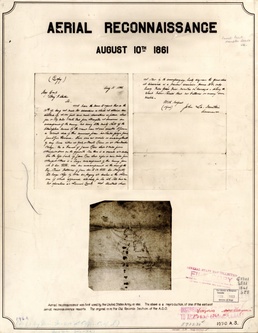
On Aug. 10, 1861, John La Mountain reported on an aerial reconnaissance mission he had performed over Fort Monroe, Virginia, from the transport ship Adriatic. His brief career as an Army civilian aeronaut would push the boundaries of what commanders thought possible of aerial intelligence at that time.
John La Mountain was born in Troy, New York, in 1830, but little is known about his early life prior to his involvement in aeronautics in the 1850s. Alongside experienced aeronaut John Wise in 1859, he set the long-distance flying record with a twenty-hour balloon flight from St. Louis to New York. Wise and La Mountain bitterly parted ways soon after due to the crash landing that had damaged their equipment. La Mountain continued to gain notoriety amongst the American public through frequent writeups of his exploits in various newspapers.
When the Civil War began in April 1861, La Mountain was one of several aeronauts who sought to promote their trade to various Union commanders. He advocated the use of balloons for intelligence operations, believing them the superior method for reconnoitering enemy encampments and maneuvers. Another prominent aeronaut, “Professor” Thaddeus S.C. Lowe, gained personal support from President Abraham Lincoln and was made commander of the Union Army Balloon Corps in August 1861. La Mountain, meanwhile, was rejected by the War Department and was instead hired as personal aerial observer for Maj. Gen. Benjamin F. Butler, commander of the Department of Virginia, at Fort Monroe in late July 1861.
Virginia had seceded from the Union in May, and Fort Monroe was surrounded by Confederate activity. General Butler’s force had been greatly reduced, making it nearly impossible to hold any forward position. During the last week of July, La Mountain made his initial aerial ascents with his balloon Atlantic—the first aerial reconnaissance operation of the war—and discovered a hidden Confederate camp near Sewell’s Point opposite Fort Monroe on the James River.
During his time with Butler, La Mountain became perhaps the first aeronaut to operate a balloon over water while tethered to a transport ship. He did this twice on Aug. 10, 1861, once during the night, where he estimated enemy troop strength by counting individual campfires. He reported to Butler a force “from four to five thousand” a few miles from Hampton, more large camps opposite Newport News on the James River, and “two large Ships of War” anchored in the harbor at Norfolk. He also provided a diagram of guns he’d located along the coast of Sewell’s Point. According to researcher Timothy Dennée, La Mountain’s aerial reconnaissance provoked the Confederates to “camouflage their artillery positions in the day and order blackouts at night.”
These would be the last two aerial missions La Mountain performed for Butler before the commander was replaced by Maj. Gen. John E. Wool. La Mountain continued to assist the Union aerial reconnaissance effort for various commanders in Virginia and Maryland. Meanwhile, he also promoted his “free ascension” method, forgoing the typical technique of tethering the balloon to the ground or a ship and instead using prevailing winds to sail the balloon higher and farther over Confederate lines. While this method provided potentially valuable intelligence on Confederate positions far behind enemy lines, the information was difficult to verify and often disregarded by commanders. This method also led to the loss of La Mountain’s balloon Saratoga in the fall of 1861.
In early 1862, against his wishes, La Mountain was ushered into the Balloon Corps and subordinated to Lowe. Lowe’s fervent dislike of La Mountain’s free ascension method, mixed with their personal and professional disdain for one another, led the relationship to deteriorate rapidly. As the more senior balloonist with more political sway, Lowe ultimately prevailed when their refusal to work together led to La Mountain’s dismissal from Army service in February 1862. He lived the remainder of his life in relative anonymity until his death in 1870.
***
Article by Erin E. Thompson, USAICoE Staff Historian. New issues of This Week in MI History are published each week. To report story errors, ask questions, request previous articles, or be added to our distribution list, please contact: TR-ICoE-Command-Historian@army.mil.