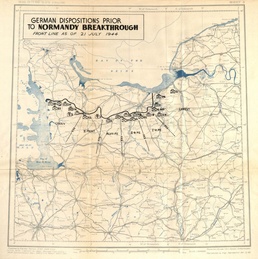
On July 22, 1944, Lt. Gen. Omar Bradley’s 12th Army Group established its command post near Colombieres, France, a short distance inland from Omaha Beach. Brig. Gen. Edwin Sibert’s G-2 Section joined the headquarters. Shortly after setting up, Sibert’s section had to adjust its intelligence gathering, processing, and dissemination methods to support Operation COBRA and the subsequent pursuit of retreating German forces.
Sibert, a 47-year-old career artilleryman, had officially served as Bradley’s army group G-2 for only eight days before moving to France. He had organized his staff into four major branches: Administration, Counterintelligence, G-2 (Air), and Intelligence. In addition to providing personnel and supply functions, the Administration Branch supervised the attached Military Intelligence Service teams. The Counterintelligence Branch worked to hinder enemy intelligence and prevent sabotage, while G-2 (Air) produced and disseminated aerial intelligence on the enemy situation. The G-2’s “core analytical component” was Col. Alexander Standish’s Intelligence Branch, which maintained detailed information about enemy units and their positions.
Initially, Colonel Standish’s analysts focused on tracking the piecemeal, frantic arrival of German reinforcements into Normandy. They meticulously mapped out a highly degraded enemy order of battle as they monitored the German Seventh Army’s disintegration. They plotted the Germans’ hasty and desperate efforts to block the Allied advance. The branch observed that air interdiction forced German units—such as the 276th Infantry Division—to abandon rail transport and march up to 100 miles on foot, arriving exhausted and under-equipped. “The pressure was such,” the G-2 later noted, “that apparently the enemy was unable to build up any reserve with which to mount a counterattack.”
On July 25, the American First Army achieved a breakthrough of German lines in Operation COBRA, allowing the Third Army to break out into the Brittany peninsula and then eastward across France. Sibert’s G-2, with the help of ULTRA intelligence, enabled General Bradley and his commanders to anticipate an armored counteroffensive at Mortain in early August. This defensive victory paved the way for the encirclement of the German Seventh Army and Fifth Panzer Army in the Falaise-Argentan Pocket by mid-August.
The speed of the American advance forced a shift in how the G-2 managed combat mapping. Initially, the G-2 Situation Room maintained detailed 1/100,000-scale tactical maps that tracked enemy positions down to individual regiments. As the American armies surged across France, the frontline became fluid. The G-2 abandoned the 1/100,000-scale maps entirely, shifting to a broader 1/250,000-scale theater map to keep pace with swift divisional movements. To maintain data integrity amid the fast-changing situation, analysts used a Master Regiment Chart. Units in confirmed active combat were marked in black; if an enemy regiment went uncontacted for more than five consecutive days, its registry color shifted to red, highlighting that the unit was likely captured, destroyed, or in total retreat.
As the Allied forces approached Paris, the intelligence staffs faced a new challenge: the liberation of cities and the safe recovery of critical enemy documents and records. In late July, Sibert organized a specialized “T Branch” to oversee combined intelligence and counterintelligence assault teams—T Forces—rushed into newly liberated cities to secure industrial, military, and scientific installations before fleeing German troops could destroy them. The liberation of Paris served as the successful field test for subsequent T Forces.
In late July and early August 1944, American forces in France shifted from a static beachhead consolidation to a fast-paced pursuit. The 12th Army Group G-2 adapted its operations by implementing both more flexible order-of-battle tracking and situation mapping. Moreover, Sibert’s staff demonstrated organizational agility with the development of the T Force concept.
***
Article by Michael E. Bigelow, INSCOM Command Historian. New issues of This Week in MI History are published each week. To report story errors, ask questions, request previous articles, or be added to our distribution list, please contact: TR-ICoE-Command-Historian@army.mil.