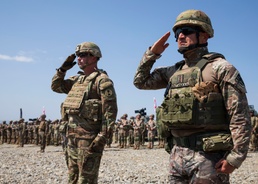
MARIETTA, Ga. — For more than three decades, the National Guard State Partnership Program has paired U.S. states with partner nations to build military capability, improve interoperability and develop relationships that can endure changes in leadership, policy and regional priorities.
For the Georgia National Guard, those relationships stretch from the country of Georgia, a partnership established in 1994, to Argentina, which joined the State Partnership Program with Georgia in 2016.
Together, the two partnerships offer examples of the program at different stages of maturity. In the country of Georgia, years of cooperation have helped develop a noncommissioned officer professional development system that Georgian forces now operate independently. In Argentina, the Georgia National Guard is preparing to expand similar NCO development efforts as part of a broader effort to increase interoperability and strengthen partnerships in the Western Hemisphere.
The State Partnership Program operates with a relatively small portion of the United States' overall security cooperation resources. According to National Guard Bureau officials, the program accounts for approximately one percent of the defense security cooperation budget while supporting nearly 30 percent of geographic combatant command engagements.
“By cultivating long-term, career-spanning relationships, SPP provides Geographic Combatant Commands with unmatched access, interoperability and partner capacity,” Lt. Col. Joshua Patterson, director of strategic plans and policy, said. “The strategic value of SPP is summarized in a single core truth: credibility cannot be surged.”
State partnerships allow Soldiers and Airmen to work with the same partner nations over years or decades, allowing relationships and capabilities to build over time rather than beginning again with each new mission.
Over the course of the partnership, Georgia Guardsmen worked alongside their Georgian counterparts to develop professional military education for the country's NCO corps. The effort has progressed to the point that Georgian forces now operate the NCO academy themselves, while Georgia National Guard personnel have transitioned primarily to observing its continued development.
Georgian NCOs are also serving at higher levels within their formations, including at the battalion and brigade level. The academy's handoff demonstrates one of the program's long-term objectives: helping partners develop capabilities they can sustain independently.
Just as important as the individual capabilities developed through the program, however, is the durability of the relationships behind them. "The biggest success is the endurance of the relationship to remain steady even during turbulent times, despite the political swinging of the pendulums," Maj. Natasha English, State Partnership Program Director, said. That endurance has allowed the Georgia National Guard and its partners to expand cooperation into new mission areas as security requirements evolve.
Cyber defense is one example.
Personnel from both partner nations have participated in Cyber Dawg, an annual exercise in Georgia focused on cyber preparedness, information sharing, and response to simulated cyber incidents. This September, participants include two representatives from the country of Georgia, six from Argentina and the commander of Argentina's Joint Cyber Defense Command. Georgia Army and Air National Guard cyber personnel support the partnerships through exercises, advisory efforts, and tabletop training.
While the partnership with the country of Georgia demonstrates what sustained cooperation can produce over decades, Georgia's partnership with Argentina represents an opportunity to apply lessons from a mature partnership to a relationship that is newer.
The next step includes an Air National Guard NCO professional development exchange planned for November, with Army-focused NCO development expected to follow. The effort remains in its planning stages, with an aim of strengthening Argentina's NCO corps and expanding its professional development capacity.
The effort also supports a broader U.S. emphasis on strengthening partnerships in the Western Hemisphere. By improving interoperability, building institutional capacity and maintaining persistent military-to-military relationships, SPP reinforces U.S. partnerships and helps deter outside influence in the region.
For Argentina, that cooperation extends beyond NCO development. Current and future engagements are expected to support regional security priorities, including counter-cartel cooperation, efforts related to illegal mining, cyber preparedness and other shared challenges.
Future planning is expected to expand those opportunities through larger joint exercises as interoperability between the forces continues to grow.
The ability to expand into new mission areas is part of what makes long-term state partnerships valuable. Relationships originally developed through conventional military exchanges can later support cyber defense, CBRN preparedness, professional military education, domestic response, and other emerging requirements without having to establish new partnerships from the ground up.
In 2025, National Guard officials reported that more than 1,000 State Partnership Program training and exchange activities were conducted worldwide while the program continued to account for approximately one percent of the U.S. security cooperation budget. National Guard officials have described those partnerships as a force multiplier for geographic combatant commands. For Georgia Guardsmen, the return on that investment is measured not only in the number of engagements conducted, but in what remains after an engagement ends.
More than 30 years after the Georgia National Guard began its partnership with the country of Georgia, Georgian forces are now sustaining capabilities that were developed over years of cooperation. As the Georgia National Guard expands similar efforts with Argentina, the program continues to demonstrate how relatively small investments, reinforced through persistent engagement, can produce lasting military capability, stronger interoperability and relationships that endure well beyond a single training event.