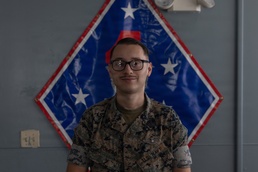
Whether it’s patrolling the hills of Horno or conducting live-fire ranges, the readiness of an infantry division relies as much on cognitive resilience as it does on physical conditioning.
For U.S. Navy Hospital Corpsman 2nd Class Josue Romero, a behavioral health technician with Headquarters Battalion, 1st Marine Division safeguarding that resilience is a full-time mission.
Romero, a native of Nevada, assists medical providers with crisis interventions, patient intakes, follow-up evaluations and group therapy sessions. Working with 1st Marine Division units, Romero’s daily operational tempo shifts rapidly to meet operational demands, which may include conducting walk-in psychological evaluations for commands.
“We have the capability of going to different units and checking up on people, seeing how everything is functioning and showing them, ‘hey we’re here,’” Romero said. Romero views behavioral health as directly tied to combat readiness, emphasizing that untreated emotional and mental health concerns can affect a Marine’s physical performance, decision-making, and overall safety.
“Let’s say for example, they’re having sleep concerns for whatever reason, they haven’t been eating well, they’ve been depressed.,” Romero said. “Now you put this Marine in a 7-ton to conduct whatever training operation. They fall asleep behind the wheel, now they’re putting themselves and others at risk.” Embedded with Marines, Navy medical personnel frequently share the same field conditions as the Marines they support, eventually establishing a baseline of trust. Romero says he gains a deeper understanding of the Marines he serves through those shared experiences.
“Because we work so closely with Marines, we have that personal experience too. We understand what they’re going through.” Romero said. “Just knowing that they have somebody they can rely on, that they feel comfortable talking to about what they have going on is something that feels like no other. I take a lot of pride in that.” Romero encourages small-unit leaders and peers to look for signs of distress such as changes in hygiene, social isolation, irritability or decline in job performance. A persistent challenge is the stigma that seeking mental health support is a sign of personal or professional weakness. Romero urges Marines to not ignore their problems, but to view mental health concerns like a check-engine light. Whenever it does turn on, he wants Marines to know there are resources available. “Our doors are always open,” said Romero.
Marines and Sailors seeking confidential support can access installation resources through the Community Counseling Center, the Department of Defense inTransition program, or Military OneSource at 1-800-342-9647.