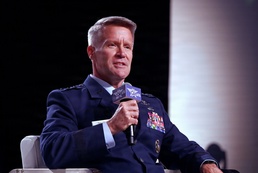
Lt. Gen. Daniel Tulley, commander of Air Mobility Command, joined fellow commanders and senior leaders to address service members, defense industry partners and journalists during the Air and Space Forces Association’s Air, Space and Cyber Conference, Sept. 16.
Tulley joined Gen. S. L. Davis, commander of Air Force Global Strike Command, Lt. Gen. Linda Hurry, commander of Air Force Materiel Command and Maj. Gen. Jon Eberlan, Director of Logistics, Engineering and Force Protection, Headquarters Air Combat Command, for a panel discussion focused on the Chief of Staff of the Air Force's operational imperative to fly and fix aircraft to deter adversaries and, if deterrence fails, to fight and win decisively in contested theaters.
Addressing the current tempo of operations, Tulley highlighted that Air Mobility Command has roughly 300 aircraft deployed across several geographic combatant commands, supported by approximately 10,000 Airmen operating at an intense tempo. He stressed that strategic air refueling is only a fraction of the total support required to sustain the Joint Force. AMC also delivers the supplies, the munitions, the sustainment and the base operating support that combatant commanders count on.
"Air refueling is just part of the story," Tulley said. "What strikes me is the lessons that they're bringing back. We've got a generation of Airmen who are going to come back home with combat experience that will be priceless for [countering] our pacing threat."
When asked about managing readiness with a largely fixed inventory of aircraft, Tulley challenged legacy, binary models of preparedness, advocating for systems that measure combat capability in a protracted fight.
"When we think about readiness in Air Mobility Command, we really think about answering four questions: readiness of what, for what, for when, and at what cost. But when we look at the lessons in Ukraine, we also have to ask ourselves: for how long?" Tulley stated. "Readiness in contact is the way we're approaching this."
To illustrate the joint teamwork required to generate readiness in contact, Tulley noted that AFMC pushed forward depot-level capabilities to Royal Air Force Mildenhall, United Kingdom, where maintenance teams have successfully swapped 30 KC-135 Stratotanker boom assemblies in-theater rather than flying the aircraft back to the United States for repairs.
Turning to the challenges of concurrent global demand and operating across multiple theaters, Tulley explained that AMC functions as the global air component to U.S. Transportation Command, balancing requirements across 11 combatant commands.
"For us, it's really about discerning the requirements across those combatant commands to include TRANSCOM's own, and then their priorities," Tulley explained. "What we really need, and what we're moving towards, is a system that lets us see all 11 combatant commands."
Addressing the pilot pipeline and training constraints, Tulley emphasized that the command is looking at the entire enterprise to ensure experienced aircrews are in operational squadrons.
"At the end of the day, we really need experience in the squadrons," Tulley said, noting that he recently convened a team to examine how the command can simplify its training requirements. "How much time do we spend in training now? What are our requirements for all of our mission sets. How can we simplify that? Always assure we have the basic level of readiness to keep the global transportation system operating, but then tailor the training we need for that high-end fight."
To highlight the reality of operating and fixing aircraft while under fire, Tulley recounted a recent real-world mission where a KC-135 aircrew and maintenance team sheltered during a ballistic missile attack, then immediately emerged to contain a major fuel leak, patch shrapnel holes and repair the aircraft so it could complete a transoceanic flight home for depot restoration. Tulley stressed that readiness is a vital, continuous process for the command.
"Pretty simple for us: train like you fight, train like you will fight in a peer fight," Tulley said. "Training like you fight has got to stress our Airmen. It’s got to train them to be ready for those stresses, and then do it again and again and again."
Tulley concluded by discussing the evolution of contested logistics, highlighting that AMC has adapted to track detailed replacement parts for aircraft in contested theaters, alongside combat munitions shipments.
"One of the things I'd say about logistics and supply lines are that we are good, but we're getting better," Tulley stated. "If you can get to the granularity and the precision to say, 'Okay, I need these [Mission Impaired Capability Awaiting Parts] delivered with those munitions,' you're increasing combat capability. You're turning aircraft back into the fight faster."
As AMC continues to operate at a sustained global tempo, Tulley emphasized that the command’s advantage rests on its ability to generate, sustain and regenerate combat capability under contested conditions. By integrating maintenance, logistics, training and operational planning across the mobility enterprise, AMC is working to ensure its Airmen and aircraft can support the Joint Force wherever and whenever they are needed.