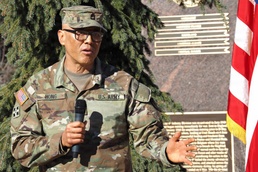
Fort Carson SRU: Rising Above . . . Finding a Way! (2007-2027) This is the second in a series of feature articles on the amazing Soldiers who have walked through the doors of the Fort Carson Soldier Recovery Unit and found success in their transition back to the force or civilian life. The series highlights the courage, perseverance, and resilience of those who have faced life-changing illnesses and injuries and found meaning and purpose as they continue to write the next chapter of their life story. These Soldiers, and the cadre and staff who supported them, leave an enduring legacy for good.
Featured Soldier: Sgt. 1st Class David Hong
Hometown: San Diego, California
Military Occupational Specialty (MOS): Religious Affairs Specialist (Chaplain’s Assistant)
By Sgt 1st Class Sebastien Fournier, Fort Carson Soldier Recovery Unit
Before joining the Army in 2009, Sgt. 1st Class David Hong felt a deep calling to ministry. He found his purpose in the Army as a Religious Affairs Specialist – a role demanding that he constantly put the spiritual and emotional needs of his fellow Soldiers above his own. Since that time, he has dedicated nearly 17 years of his life to taking care of others.
In July 2022, shortly after returning from a year-long deployment to Korea, Hong was serving as the senior Religious Affairs NCO for the Fort Carson garrison. Approaching 50 and navigating a demanding operational tempo, he followed a physician’s recommendation to get a routine screening colonoscopy.
The results were devastating. Doctors discovered a severe blockage and diagnosed him with stage IV colon cancer.
"To be honest with you, if I didn't get that colonoscopy, I would probably not be here talking to you," Hong reflected.
Initially, Hong tried to push through, attempting to balance his demanding military duties with his first grueling rounds of chemotherapy. The physical toll was immense, and it quickly became apparent that he needed a dedicated environment to fight for his life. In September 2023, his First Sergeant gave him a direct order: it was time to transition to the Fort Carson Soldier Recovery Unit.
The Turning Point: Learning to be a Patient Transitioning to the SRU required a monumental shift in mindset. For a senior NCO accustomed to leading and caring for troops, stepping back was the ultimate challenge.
"Not being able to do my job as a Religious Affairs NCO was the hardest thing," Hong explained. "It took me almost a year to accept that I had to focus on being a patient. I learned self-care here, which is hard for NCOs because we're used to taking care of others."
Once assigned to the SRU, Hong was met with a comprehensive, synchronized care network. From nurse case managers and social workers to squad leaders and the command team, administrative and logistical burdens were lifted off his shoulders.
This support proved vital as he endured more than 30 rounds of chemotherapy, a major liver resection surgery in April 2024, and the demands of family life, which includes caring for a special needs child.
"I remember one of the battalion commanders called me while I was sitting in the chair getting ready for surgery and said, 'Hey sergeant, we're praying for you, just hang in there,'" Hong recalled. "That was huge. Having the team and resources made it easier to go through the treatments and transitions."
The Discipline to Pursue an Ambitious Dream While at the SRU, Hong was introduced to adaptive sports through the Army Recovery Care Program. Despite the debilitating effects of long-term oncology care, he committed to an intense, bi-weekly schedule that alternated chemotherapy infusions with high-performance training.
Because chemotherapy left Hong severely immunocompromised, Coach Colin at Fort Carson’s Garcia Gym adapted to protect his health, opening the facility an hour early, allowing Hong to train safely in isolation before other athletes arrived. When scheduling racing chair track sessions became difficult around infusion dates, Hong adapted by using the ski ergometer to simulate stroke mechanics.
Navigating heavy physical training under intense chemotherapy required a strict, targeted nutritional regimen. Hong credits his wife Monica as his de facto nutritionist. She developed a disciplined, organic plant-based protocol, handled daily juicing, raw food prep, and the logistics of specialized meals at home and on the road. Eventually he added in some protein such as fish but completed the bulk of his training fully vegan.
Warrior Games: Defying the Odds Hong’s disciplined regimen earned his spot to represent Team Army at the Department of Defense Warrior Games in both 2025 and 2026. He competed in an exhaustive roster of events across multiple disciplines, to include track and field in recumbent racing chair events, seated shot put, and seated discus, cycling, archery, and sitting volleyball.
"Training while doing treatment was very difficult, but having the support made it easier," Hong said. "It's not about medaling; it's about being part of that community. Track and field was the most challenging because I did every single event... It was a complete team effort across all service branches, supported by great coaches and cadre."
Positivity, Gratitude, and Enduring Service Throughout his tenure at the SRU, Hong became known across the battalion for his unwavering optimism, radiant joy, and selfless concern for others. When asked where his resilience originates in the face of a terminal diagnosis, Hong points directly to his spiritual foundation.
"Personally, it’s my faith in God. Even with a terminal illness, I try not to be bitter. Treatment isn't fun, but you have to stay positive, love the people around you, and encourage others," Hong stated. "I’m not the only one going through struggles. Cancer is horrible, but I look at the positive aspects and see how God is using this journey as a testimony to help others overcome their challenges. I didn't do this on my own—God used the SRU, the doctors, and everyone I’ve encountered along the way."
In June 2026, Hong was medically retired from active military service. Facing the reality of a terminal illness, his focus has shifted to maximizing time with his family – to include his three daughters and one grandson. As his condition eventually progresses, his wife will step into the role of his primary caregiver.
Despite all of that, Hong's desire to serve remains as strong as ever. Grateful for the support he received from his entire care team at the SRU, Hong feels a calling to spend some of his remaining time volunteering to help connect transitioning veterans with adaptive sports and other critical resources.
"The legacy I want to leave is that anybody can do what we did as athletes," Hong emphasized. "Even though you're going through treatment, if you have the right support like this SRU, you're able to train... It gives me a vision that as I transition to civilian life, I still want to support Soldiers, their families, and veterans."
About the Fort Carson SRU The Fort Carson SRU opened its doors on June 2, 2007, as one of 45 Warrior Transition Units stood up during the peak of catastrophic casualties from the Global War on Terror. Today, Fort Carson is one of 14 remaining Soldier Recovery Units that have served and supported the Army’s wounded, ill and injured Soldiers for almost two decades. Due to the continued decrease in demand and increasing capability to remotely manage less complex medical cases, Fort Carson along with 9 other SRUs will close in 2027.
The Fort Carson SRU has served more than 4,500 Soldiers in Recovery. Almost 500 Soldiers have returned to Active Duty and continued to serve, with another 600 Reservists and National Guard members returning to their units. Another 3,300 have transitioned to civilian life.