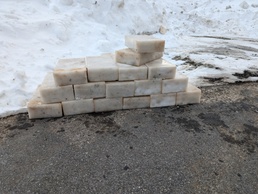
In the Arctic and similar extreme cold climates, quickly building fortifications can mean the difference between mission success or failure, or even life and death. But transporting construction materials in these environments is arduous and costly, and locally sourced materials such as wood or stone are extremely scarce, if not non-existent.
But these locations do have one potential construction material in abundance – snow. Turning that snow into uniform, modular building blocks was the goal behind a research project recently conducted by a team of scientists from the U.S. Army Engineer Research and Development Center’s Cold Regions Research and Engineering Laboratory (CRREL).
“If you’re in a remote Arctic location, every pound of material you don’t have to fly in is a big deal,” said Dr. Katie DiDominic, a CRREL research environmental engineer and lead author on the study documenting the team’s findings. “If we can use the snow that’s already on the ground to quickly build sufficient protection barriers, shelters, or other infrastructure, that could reduce the logistical burden while giving warfighters more options in the field.”
Snow is already widely used to construct fortifications, but they are typically built by compacting snow in place using hand tools and boots. This requires a lot of time and effort, and it doesn’t provide the consistency of materials that compressed snow blocks (CSBs) offer.
The CRREL researchers set out to study whether a compressed earth block machine that was commercially available could produce CSBs with the consistency and characteristics needed to build protective barriers, ballistic protection, shelter, equipment and vehicle storage or windbreaks.
“Instead of asking ‘can we develop and build a machine that makes snow blocks? We skipped to ‘can an existing machine do it?’” said DiDominic.
At the advice of the manufacturers of the earth compressing machine – who were also quite interested in learning if their machines could build snow blocks – the team set the machine’s pressure to 3000 PSI and shoveled naturally occurring snow found on the ground of its New Hampshire laboratory into the machine. The team then measured the resulting CSBs’ mass and dimensions to calculate density.
The result? A successful demonstration that the machine could produce CSBs with relatively consistent dimensions and suitability for shaping snow for structural purposes.
“At the very outset of the project we wanted to answer a simple question: ‘could this actually work with snow?’” said DiDominic. “And the answer was ‘yes, it definitely does.’”
In fact, the process worked so well that many of the blocks reached densities that would technically classify them as glacial ice.
Now that they’ve shown that the general concept of CSBs is feasible, the research team is interested in optimizing both the equipment and the construction process.
“We’d like to explore the strength and ballistic performance of the blocks, whether additives could improve performance, and how they might perform in realistic field applications such as expeditionary construction and force protection,” added DiDominic.
One area ripe for improvement is block construction rate.
“Even with the speed of 300 blocks per hour, the small size of the blocks would take quite a while to build a structure of good size for any military-specific use,” surmised DiDominic. “Eventually we’d like to develop a military-specific piece of equipment that makes larger blocks, faster, and is more mobile and suited to operate in cold environments.”
A version of the article first appeared in the https://www.same.org/tmeissue/tme-september-october-2026/ of The Military Engineer magazine. Republished with permission.