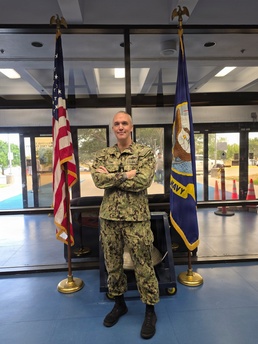
By Capt. Javier Agraz, MC, USN Executive Officer, Navy Medicine Readiness and Training Command Corpus Christi CAPE ST. CLAIRE, MD. — The explosion came without warning.
One moment, Chief Hospital Corpsman Joseph Toms, assigned to Navy Medicine Readiness Training Command Corpus Christi, was sitting inside his father’s home in Cape St. Claire, Maryland, preparing a speech for his younger brother’s wedding. The next, a thunderous blast shook the neighborhood.
Toms stepped outside and saw a nearby two-story home had disappeared. In its place stood a towering cloud of smoke and a mountain of collapsed wood, insulation, and shattered debris.
He did not hesitate.
Toms and his brother, Benjamin, dialed 911 and moved toward the wreckage, where neighbors reported residents remained trapped. Faced with an unstable structure, exposed debris, and potential for additional hazards, Toms drew on his training and experience as a Navy Corpsman to assess the situation and determine where help was needed.
The brothers called out as they carefully worked their way through the collapsed structure. Moving through the wreckage, nails tore through Toms’s footwear and sharp, splintered beams cut his hands and arms. He pressed forward until he spotted a woman’s feet beneath a collapsed section of the roof. Reaching for her, Toms quickly assessed her airway and breathing and detected a faint pulse.
Joined by his brother and neighboring bystanders, Toms helped lift the heavy roof section and pulled her to safety. When local emergency medical services arrived on scene, they immediately assumed critical care. Despite collective lifesaving measures, she later succumbed to her injuries at the scene.
Yet another resident remained unaccounted for.
Toms and his brother continued through the debris field calling for the missing resident. As smoke, heat, and airborne fiberglass made conditions increasingly hazardous, Toms directed his brother away from the most dangerous area while continuing to call out for the missing resident.
After what Toms described as several agonizing minutes, he heard a faint voice. Catching sight of slight movement, he located the second resident pinned within the rubble. The severely injured homeowner was extricated and airlifted by Maryland State Police aviation to the regional burn center at Johns Hopkins Bayview Medical Center in Baltimore, where he later succumbed to his injuries.
Following the rescue operation, Toms was treated for lacerations, heat exhaustion, and acute respiratory irritation resulting from fiberglass and smoke inhalation.
Investigators later confirmed the catastrophe was accidental: a propane line had been inadvertently compromised during residential maintenance on the home’s HVAC system, permitting gas accumulation that ignited upon a spark from a metal grinder.
Toms was not on duty that afternoon. He was not standing a medical watch, participating in a field exercise, or treating patients inside a military treatment facility. He was a son and brother gathered with family to celebrate a joyful milestone.
Yet when disaster struck, he remained, above all, a Navy Corpsman.
His actions reflected the readiness Navy Medicine develops across its force: the ability to remain composed in chaos, rapidly assess casualties, apply medical knowledge under pressure, work alongside others and act decisively when lives are at stake. Those same attributes underpin Navy Medicine’s ability to support Sailors and Marines wherever they operate.
The response also demonstrated that readiness is a team effort. Toms, worked alongside his brother, neighbors, local emergency medical personnel and Maryland State Police as military training and civilian emergency response converged around a common purpose—saving lives.
The Hospital Corpsman Pledge declares: “I solemnly pledge myself before God and these witnesses to practice faithfully all my duties as a member of the Hospital Corps. I hold the care of the sick and injured to be a privilege and a sacred trust...”
For Toms, those words were more than a ceremonial recitation. His response demonstrated the value of his training, standards and professional competence expected of a Navy Corpsman. In an unfamiliar environment and under extraordinary pressure, he applied causality-assessment skills, physical endurance and sound judgement in service to people he had never met.
Navy Medicine’s mission is to develop medically ready forces capable of supporting the Navy and Marine Corps in the environments where they may be called to fight. That readiness depends on people who are trained, competent, physically prepared and able to make sound decisions under pressure. The capabilities Toms relied upon in Cape St. Claire—casualty assessment, composure, teamwork and decisive action—are the same foundational attributes Navy Medicine develops to sustain the warfighter and contribute to a more ready and lethal force.
For more than a century, Hospital Corpsmen have carried those capabilities from clinics and hospitals to ships, expeditionary environments and battlefields around the world. In Cape St. Claire, Chief Joseph Toms demonstrated readiness when it was unexpectedly needed at home.
Navy Medicine's 44,000+ talented and ready forces optimize health readiness, deliver quality healthcare, and provide global expeditionary medical support to warfighters.