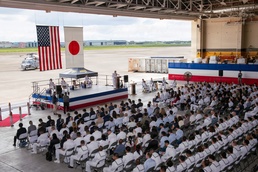
NAVAL AIR FACILITY ATSUGI, Japan – On Aug. 20, 2026, Capt. Jeff Schwab officially relieved Capt. Nicolas Leclerc as the commanding officer of Naval Air Facility (NAF) Atsugi during a traditional change of command ceremony held onboard the installation.
The transition marks a new chapter for the vital Western Pacific hub, which serves as a critical logistics, maintenance, and flight operations base shared alongside the Japan Maritime Self-Defense Force (JMSDF).
Following opening remarks by guest speaker, Rie Suetomi, Minister’s Secretariat, Ministry of Defense, Japan, Leclerc took center stage. After acknowledging senior leadership and distinguished guests in attendance, he proceeded to address the audience.
“Serving here [NAF Atsugi] has given me a front-row seat to one of the most consequential partnerships in the world: the U.S.–Japan alliance,” said Leclerc. “It is not an abstract concept. It is lived every day — on this base, in this community, and across the Pacific. And it is becoming more important, not less, as the region continues to evolve.”
Leclerc proceeded to say that the Pacific is currently experiencing the most significant strategic shifts in decades and that there was increasing competition for influence, rapid military modernization, and expanding gray-zone activities at sea and in the air.
This also includes challenges to the rules-based international order, which has kept the region stable and prosperous. Furthermore, he added that nations across the region look towards the United States and Japan — not just for security, but for leadership, consistency, and partnership.
“The alliance is how we meet these challenges,” said Leclerc. “It is how we deter aggression, reassure partners, and maintain stability in a region where stability cannot be taken for granted.”
He stated that this could be seen in NAF Atsugi’s daily cooperation with the Japan Maritime Self Defense Force (JMSDF).
“Our forces train together, plan together, and operate together with a level of trust that is rare in international military relationships,” said Leclerc. “Whether it’s coordinated maritime patrols, air operations, or joint exercises, our interoperability is real. It’s not just a talking point — it’s a capability. And it’s one that strengthens deterrence across the region.”
Leclerc did not limit his views of relationships to just the armed forces.
“The alliance is not only military. It is also human,” said Leclerc. “It is the daily relationship between this base and the people of Ayase, Yamato, and the surrounding communities. It is the friendships formed, the cooperation built, and the mutual respect that grows year after year.”
“To our Japanese friends and neighbors, I want to say;“Minasama no atatakai go-shien to go-rikai ni, kokoro yori kansha mōshiagemasu,” said Leclerc. “Your partnership makes this base stronger, safer, and more connected. Thank you for welcoming our sailors and families into your community. It has been one of the greatest privileges of my career to serve here.”
Leclerc also expressed his deep gratitude to the civilian staff, host-nation partners and especially the Sailors who all keep NAF Atsugi operational.
“[You are] a diverse team with countless specialties, working together to ensure the Navy’s missions are safely executed, and that our sailors and families have a stable, secure place to live and work,” said Leclerc. “You do the hard work. You make the difference. You are the reason this base succeeds.”
He continued.
“If anyone ever doubts the strength of the U.S.–Japan alliance, I invite them to spend one day watching our sailors and JMSDF partners operate together. The proof is right here on Atsugi.”
Retirement looms
The change of command also marked the end of Leclerc’s 26 years of service in the United States Navy.
He acknowledged his parents, wife and children as all positive influences on his career and that he was looking forward to another new chapter of his life with them.
“I’m proud of my service, but I’m also humbled by it,” said Leclerc. “The Navy has taken me around the world, put me in the cockpit with incredible aviators, and given me the privilege of leading sailors whose dedication never wavered, even when the hours were long and the challenges were real.”
He stated that he learned that leadership is never about the person speaking in the microphone at a podium. It’s about the people who show up every day, do the work, and make the mission happen.
“If I’ve accomplished anything, it’s because I stood on the shoulders of those who served with me,” said Leclerc. “As I move on to new challenges, I carry those lessons with me.”
Schwab sets foot as the new Skipper at NAF Atsugi
Schwab, an accomplished naval aviator who previously served as the Commanding Officer of Helicopter Sea Combat Squadron (HSC-23 stepped forward to read his orders and officially assumed the role of NAF Atsugi commanding officer.
“We must recognize that while the US-Japan Alliance is the cornerstone of peace, security, and prosperity in the Indo-Pacific, that alliance does not exist without the hard work of the people in this very hangar,” said Schwab. “To that end, NAF Atsugi will serve as the model for US-Japan integration and interoperability. We will work together, we will train together, we will succeed together and ultimately be stronger together.”
Before closing his remarks, Schwab reminded his new command of his high expectations.
“That's how excellence is built—not in one dramatic moment, but through thousands of small decisions to do things a little better, to work a little smarter, and to hold ourselves to a higher standard.”
NAF Atsugi supports the combat readiness of Commander, Fleet Air Western Pacific, Commander, Carrier Air Wing FIVE (CVW) 5, Helicopter Maritime Strike Squadron (HSM) 51 and 23 other tenant commands, and provides logistic support, coordination, and services to units assigned to the Western Pacific.