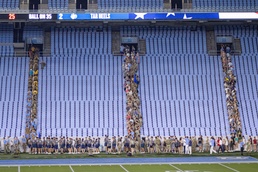
CHAPEL HILL, N.C. — Before sunrise, thousands began to climb.
They came from different communities, different universities, and different services. But at 6:30 a.m., inside Kenan Memorial Stadium, they all started moving in the same direction.
Up.
Twenty-five years after the terrorist attacks of Sept. 11, 2001, more than 4,000 people gathered at the University of North Carolina at Chapel Hill to remember the first responders who climbed the stairs of the World Trade Center that morning.
Among them were firefighters, Raleigh police officers, and members of the North Carolina State Highway Patrol. Reserve Officers’ Training Corps (ROTC) cadets from UNC, Duke University, and North Carolina State University represented the Army, Navy, Marine Corps, and Air Force. Junior ROTC cadets joined veterans, civilians, and students who woke before dawn to take part.
Members of athletic teams across the university, including UNC head football coach Bill Belichick, traded fields, weight rooms, and water for the concrete steps of the stadium.
UNC, Duke, and NC State spend much of the year as rivals, but that morning, there was no competition. Only shared purpose.
Rivals Stand Together
Cadets and students from all three universities climbed the same stairs. They encouraged one another when the climb became difficult.
UNC Chancellor Lee H. Roberts, the university’s 13th chancellor and a graduate of Duke himself, joined Army Lt. Col. Lisa Klekowski, UNC’s Professor of Military Science, before the climb.
Together, Roberts addressed a generation of students who largely have no memory of the day they had gathered to commemorate.
For many of the participants, Sept. 11 is not a memory, it is history.
They did not watch a hijacked airliner disappear into the South Tower. They did not see smoke rise above Manhattan or watch the Pentagon burn. They did not experience the collective shock of a nation trying to understand what was happening that day.
Still, they climbed.
Inheriting the Future
After the attacks of Sept. 11 came two decades of war, deployments, and counterterrorism operations that fundamentally reshaped the U.S. military, the special operations community, and an entire generation of American service members.
The cadets climbing the stairs are inheriting the lessons of that generation, but they are not inheriting the same war.
Unmanned systems have changed the relationship between distance and danger. Electronic warfare can expose a position without a shot being fired. Inexpensive technology can destroy million-dollar pieces of equipment. Information moves around the globe in seconds. Technology is at the forefront of the next war.
But technology alone will not win it.
For the special operations community, this idea is not new. Today, one of the enduring Special Operations Forces truths may be more relevant than ever.
Humans Are More Important Than Hardware
Klekowski occupies an increasingly unique position between two generations.
Before UNC, she served as an aviator with the 160th Special Operations Aviation Regiment (Airborne) and later served within the U.S. Army Special Operations Command, part of the generation of Army leaders who spent much of their careers fighting the post-9/11 wars.
Now, Klekowski is responsible for passing on the hard-earned lessons of those years to help cadets on the battlefield, while instilling the leadership attributes required to win a war that looks completely different from the last.
Regardless of how technologically advanced the next war looks, when exhaustion, uncertainty, or fear take hold, someone has to be willing to take another step and convince the person beside them that they can take one too.
Carrying History Forward
As daylight slowly reached the stadium, legs grew heavy and breathing labored. Groups that started together began to stretch across the stadium's sections.
But everyone inside the stadium knew where the stairs would end. They knew they would eventually finish, and they knew their families would see them again.
The firefighters who entered the burning towers on September 11 had none of those assurances.
They climbed anyway.