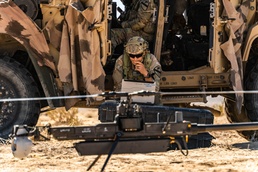
WASHINGTON — As the Army modernizes for large-scale combat operations, its premier combat training centers (CTCs) manage a dual mission: training and validating immediate unit readiness while systematically testing the technologies destined for future battlefields.
Speaking during a recent media briefing, Lt. Gen. James P. Isenhower III, commanding general of the U.S. Army Combined Arms Command (CAC), outlined how the command is modernizing training at the National Training Center (NTC) at Fort Irwin, California, and the Joint Readiness Training Center (JRTC) at Fort Johnson, Louisiana.
Following structural realignments under the Army Transformation Initiative and the establishment of T2COM, CAC regained purview and collective training funding for both JRTC and NTC. This realignment unifies force development, doctrine, education, and collective training under a single institutional command.
According to Isenhower, the modernization roadmap centers on one overriding mandate: delivering lethal, combat-credible formations ready to fight and win against peer adversaries.
"Primary is our requirement to deliver readiness to the nation when called," Isenhower said. "The CTCs are an incredible capability and the envy of militaries across the world, given that they provide a crucible event to the units and truly stress them to give them confidence that they can function in extremis when called upon. However, there are also very few other more appropriate and effective opportunities to responsibly integrate experimentation."
Evolving Past Mission Rehearsals to Dynamic LSCO Proficiency
When the Army established the CTCs in the early 1980s, their core purpose was to provide rigorous, force-on-force collective maneuvers against an unconstrained, free-thinking opposing force (OPFOR). During the conflicts in Iraq and Afghanistan, CTC rotations pivoted toward mission rehearsal exercises—verifying specific counterinsurgency mission sets before scheduled deployments.
Today, the centers are completing a decisive return to high-intensity, large-scale combat operations (LSCO). Rather than acting purely as a checklist certification exercise, rotations are designed to hone collective warfighting skills, exercise multi-domain command and control, and expose formations to the chaotic friction of modern war.
"What we're seeing today and what we're leading the CTCs through is kind of a return to the original purpose focused on large-scale combat operations proficiency," Isenhower explained. "It becomes an appropriate balance of building readiness and large-scale combat expertise while also giving us an opportunity to integrate some experimentation where we can validate or invalidate the technology or the technique."
The 180-Day Rule: Priming the Training
Integrating cutting-edge commercial technology into tactical units often carries unintended consequences—chief among them, "technology fatigue" and cognitive overload for soldiers who need to focus on mission command and tactical execution.
To manage the introduction of new systems to rotational units, CAC uses its established CTC governance process in coordination with corps, division, and Army Futures Command leadership. A key component of this process is the mandatory 180-day rule.
"What I have directed is that we want to be very careful with the experimentation requirements we put on the rotational force... because we want them to focus on their processes, standards, and their operating procedures to make sure that they are tactically proficient and can employ themselves in accordance with their mission-essential tasks," said Isenhower.
Under this threshold, any new technology slated for evaluation by the rotational brigade must be fielded to the unit at least 180 days before entering "the box."
"We've established a temporal threshold 180 days out where we have to give them that equipment then, so that they have sufficient time at home station to integrate that," Isenhower emphasized. "Then ostensibly, they can focus less on the integration of that equipment during the CTC rotation and more on fighting the enemy to good effect."
Past instances where units received experimental equipment immediately before entering force-on-force maneuver demonstrated the risk of distraction. "We've realized that the reality is we owe them more time so they can integrate that equipment and focus on fighting the enemy as opposed to what oftentimes is a focus on simply trying to understand the equipment," he added.
Leveraging the OPFOR for the Army’s Tech Testbed
When emerging capabilities need rapid operational testing within that 180-day window, CAC shifts the experimentation burden from the training audience to the permanent opposing forces at NTC and JRTC. "The OPFOR at the CTCs know the terrain. There's an argument that they spend more time in the field than any other unit in the Army," Isenhower said. "It's easier for us, and with less risk to training objectives, that we can inject a piece of technology in short order with the OPFOR just because they do this routinely... and it has less of a deleterious effect on their ability to employ."
By arming the OPFOR with novel commercial unmanned aerial systems (UAS), electronic warfare emitters, and advanced sensors, CTCs achieve a dual victory: new technology is tested against realistic field conditions, and the rotational training audience faces an adversary mirroring the sophisticated, transparent threat environments seen in Ukraine and other global hotspots.
Operating in the Drone Era: Uncontested Skies Are History
A major driver behind the updated CTC scenarios is also the proliferation of unmanned systems. Rather than viewing drones as an abstract military revolution, Isenhower described them as a logical evolution that has fundamentally altered the character of warfare across reconnaissance, strike, and sustainment. Crucially, this evolution has shattered an operational assumption that guided U.S. operations for over two decades: automatic air superiority.
"One of the things that’s been stark to me is the collective recognition that we don't enjoy air superiority in a tactical environment," Isenhower observed. "For 20 years, we didn't have to worry about anything coming out of the sky. And we lost proficiency that I think we had trained in the Cold War era... where we were worried about adversaries who had fixed-wing aircraft and the capability to send long-range precision fires at us."
At both NTC and JRTC, rotational formations face pervasive drone surveillance and simulated aerial strikes. This forces training unit commanders and squad leaders alike to re-learn active protection, dispersal, camouflage, and immediate Counter-UAS battle drills.
"Our ability to integrate protection requirements—this affects the squad as it does a platoon, a company, a battalion, or a brigade—has become far more clear to us," Isenhower said. "At the combat training centers, I’ve witnessed a sea change in how those units employ, how they seek dispersion, and how they use terrain and other camouflage techniques, but also incorporate deception to present a dilemma to an opposing force that has an air capability."
Validating Tech and Tactics Through Soldier Feedback
Ensuring that modernization keeps pace with dynamic battlefield changes requires a reliable, rapid feedback loop between field maneuvers and procurement authorities.
To bridge this gap, CAC deploys Transformation Lessons Learned Managers (TLLMs) into training rotations and overseas operational exercises. These subject-matter experts collect ground-truth observations directly from soldiers and staffs under extreme conditions—such as noting when commercial drones perform well in humid Louisiana weather but struggle in European winter cold.
By institutionalizing this data flow through CAC’s Transformation Integration Directorates and passing empirical evidence directly to Army Futures Command and program executive offices, the Army avoids reliance on vendor marketing claims.
"The ultimate arbiter for me of an effective piece of technology is the soldier’s confidence in that technology and whether or not it’s helping them perform their mission," Isenhower emphasized. "If a soldier doesn’t have confidence in a piece of equipment, he’ll discard it. We don't put it on a soldier to tell a vendor something’s not working; we want to provide a consistent Army message based on the experience of experimenting in an environment where they’re going to employ it."