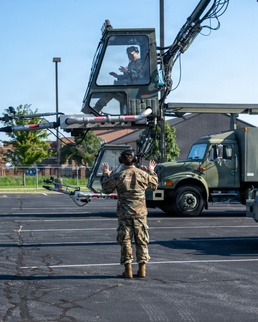
SCOTT AIR FORCE BASE, Illinois— The 126th Logistics Readiness Squadron vehicle maintenance shop hosted a two-week training on a vehicle known as the deicer.
The deicer is used to remove and prevent accumulation of ice on the wings of an aircraft.
“The Deicer is utilized as needed, but typically after heavy snowfall or freezing temperatures.” said U.S. Air Force Tech. Sgt. Tyler Goldstrom, 346th Training Squadron instructor.
Deicers are approximately 320,000 per vehicle, and they play an important role in the mission during the winter, which makes it even more crucial that the Airmen understand how they operate and how they need to be maintained.
“It's the first time that vehicle management has hosted an Air Education and Training Command funded course,” said Chief Master Sgt. James Laird, 126th LRS vehicle fleet manager. “They provided the instructor and all the curriculum. We just had to provide the location, the deicers and a few odds and ends.”
Hosting the course required Airmen from other bases to travel to Scott AFB. The process ran smoothly overall with only a few adjustments needed to accommodate the visiting Airman.
“The one challenge that I did face was preparing a welcome letter to send out to the students,” said Laird. “To give them an overview of the base so they would have a little bit of an idea of what the base looked like, where they were headed as well as what to expect once they arrived.”
The mix of airmen attending the course also included some Airmen from the 126 ARW.
“We signed up two of our very own mechanics to go through the course, because that's going to allow them to be signed off on six, five level core tasks,” said Laird. “It takes a bit of time to accomplish that outside of the course.”
The maintenance that the deicer requires provides a training opportunity for Airmen to work with the vehicle and to familiarize the airmen with the deicer outside of the course.
“Routine maintenance occurs annually and is generally called summer rebuild,” said Goldstrom. “Technicians will replace all filters, verify fluid levels, adjust burner assemblies, and perform a full operational test of the vehicle.”
While the training tasks would have been completed regardless, the training course provides a better environment for learning.
“Every summer we have to do a pretty comprehensive, summer rebuild checklist on those winter, operating vehicles like the deicers,” said Laird. “When we do that, we have a pretty long checklist that will go down and we'll get the airmen that need that type of training involved in the summer rebuilds.”
The course also gives the Airmen an opportunity to give their full attention to the information and tasks presented to them.
“That’s when we usually get our airmen their upgrade training, but the course is nice because it’s all-in-one two week period,” said Laird. “All they have to focus on is that class and the training and it’s not like they’re having to do their job at the same time.”
The course was a helpful review of the information the Airman had previously learned while in tech school. The course also provided them with valuable hands-on experience with the deicer they appreciated, said Airman 1st Class Caleb Estrada, 126th LRS vehicle maintenance specialist.
While the deicer is a vehicle, it’s impacts has a critical impact on the Wing’s mission.
“If the aircraft are iced over at all, they can't fly,” said Laird. “They end up canceling missions if we have deicer issues. We have three of those vehicles and we need to have two at least running at all times during the winter operations. It’s vital to make sure our aircraft can make it off the ground and support the mission that way.”
The students start out with a level of knowledge and prior training with the deicer before they even take this course.
“In tech school, students receive eight class days of instruction directly related to the deicer,” said Goldstrom. “This 12-day advanced course that Scott AFB is currently hosting builds off that knowledge the students received in tech school and dives deeper into subcomponents to learn how everything is interconnected.”
The safety procedures necessary for handling the deicer are taught and reinforced all throughout the course.
“Common safety procedures during operation are to wear proper hearing protection as there are two large engines which with both running can cause long term hearing loss,” said Goldstrom. “Additionally, maintaining constant communication with everybody within proximity to the vehicle is crucial as visibility can be limited at times. If communication is lost, serious injury to our Airmen who are our number 1 asset can occur.”
It’s most important that the students remember how to safely maintain the deicer. They are complicated vehicles that can easily be dangerous if not handled properly.
The deicer plays a vital role in strengthening and supporting our airpower during the winter.
“Deicer training is critical to the wing's mission,” said Goldstrom. “If aircraft can’t take off, we lose our global reach through rapid mobility and providing assistance to those who need it most.”