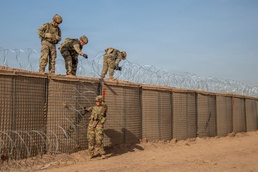
FORT BLISS, Texas — Soldiers with the 62nd Engineer Battalion, 36th Engineer Brigade, assigned to Joint Task Force-Southern Border (JTF-SB) in support of Operation Ardent Vanguard, recently reinforced a challenging section of the southern border barrier. The Soldiers developed an improvised method to emplace razor wire in rough terrain where heavy equipment could not operate.
JTF-SB Soldiers emplaced two strands of concertina wire and one strand of razor wire atop 7-foot-tall HESCO barriers in National Defense Area 1 near Fort Hancock, Texas. The operation reinforced the barriers to disrupt climbing attempts and enhance persistent detection, monitoring, and rapid response along high-risk border corridors.
“Barrier reinforcement operations represent more than physical infrastructure; they showcase the technical ingenuity and skill of our service members," said Maj. Gen. Curtis Taylor, commander of Joint Task Force-Southern Border and 1st Armored Division. "For the last 14 weeks, our great Soldiers have been out here day and night developing innovative solutions to stop human trafficking in our own territory."
In May 2026, the U.S. Navy and U.S. Army Corps of Engineers began installing 10 miles of HESCO barriers under orders from the Department of War and U.S. Northern Command. In slightly more than 30 days, they constructed 10 miles of barriers, completing site preparation, mobilization, environmental clearance, shipment of barrier sections from overseas, and transportation of more than 90,000 cubic yards of fill material.
On average, constructing 10 miles of HESCO barrier takes approximately 28 days when crews work 12-hour shifts. However, this timeline does not include the mobilization time or site prep work which consists of land clearing and compacting.
During the recent reinforcement operation, Soldiers with the 591st Combat Engineer Company-Infantry, 62nd Engineer Battalion, maintained a demanding pace as they reinforced barriers from Santa Teresa, New Mexico, to Fort Hancock, Texas.
“When we work on border reinforcement operations, we typically start in the morning and then we work until around mid-afternoon,” said 2nd Lt. Jonah Posada, a Sapper platoon leader with the 591st CEC-I. “And then we'll return to Fort Bliss and prepare for the next day. We try to continue at that pace for the whole week.”
To address site conditions and avoid the Texas summer heat, the company adopted an offset work schedule. One platoon began work in the early evening, while another relieved it and worked until late morning.
The elevated work surface and limited workspace made installing razor wire on the HESCO barriers difficult. Additionally, Soldiers could not use pickets, metal stakes generally used for support, because of the compressive stress they would place on the barriers. Instead, they used boom lifts as work platforms to emplace razor wire atop the concertina wire.
The final 300-meter section presented another significant challenge. Soft, uneven terrain prevented boom lifts from reaching the area and attempts to move the equipment resulted in vehicles becoming stuck. Rather than leave the section unfinished, Soldiers with the 591st CEC-I developed a solution using equipment already available to them.
“We devised a plan using tent poles and rope that we had in our high angle mountaineering kit,” said Posada. “Using those ropes, we stretched [the section of wire] out and kept tension on the razor wire.”
Soldiers on the ground used camouflage-net poles to lift the razor wire while teams atop the barrier secured it in place. A carabiner attached to a rope helped lift the wire from the ground, enabling the Soldiers to complete the final section without relying on boom lifts.
The solution was the latest in a series of adaptations Soldiers developed as they transitioned between traditional border-barrier work and reinforcing HESCO barriers.
The HESCO barriers introduced additional challenges because the razor-wire obstacle configuration was not standard for the engineers.
“The actual obstacle that we emplaced on top of the HESCOs is not normal,” Posada said. “We had to figure out how to best overcome that. The terrain by the HESCO was a big hindrance on the mission as well.”
The company also developed techniques to prevent injuries from contact Soldiers had with razor wire. In one method, Soldiers attached a wooden post to a boom lift and used it to position the wire across the barrier.
At the squad level, Soldiers developed and shared techniques that allowed platoons to continue working despite changing terrain and equipment limitations.
The completed work reinforces the barrier with additional obstacles intended to deter unauthorized crossings and support the broader border-security mission. U.S. Border Patrol agents working in the area expressed appreciation for the Soldiers’ efforts and noted that the additional barriers helped limit crossings.
The operation underscores the role of combat engineers in providing practical solutions when terrain, equipment and mission requirements intersect.
For the Soldiers conducting the work, the operation demonstrated the importance of adapting established engineering practices to conditions on the ground. Posada said he shared the techniques developed by his platoon with other platoon leaders in the company so they can apply the lessons learned to similar missions.
In the final stretch, Soldiers could not rely on the machinery normally used to install barrier obstacles. Instead, they used basic equipment, teamwork and field-expedient techniques to complete the mission.
U.S. Northern Command is working side-by-side with the Department of Homeland Security and the U.S. Customs and Border Protection within narrowly defined authorities to provide unique military capabilities to protect the territorial integrity of the U.S. southern border.