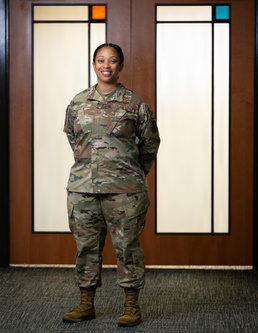
U.S. Air Force Master Sgt. Dominique Johnson serves on the Resiliency Team at Air Force Mortuary Affairs Operations (AFMAO) as a Religious Affairs Airman. In a mission defined by dignity, honor, and respect; Johnson provides emotional, spiritual and relational support to the Airmen who carry out the solemn responsibility of honoring fallen service members and supporting their families. In this “Meet the Deployer” spotlight, Johnson reflects on the purpose, challenges and lasting impact of serving in this uniquely meaningful environment.
What were your initial thoughts or feelings when you received your assignment to Air Force Mortuary Affairs Operations?
“When I received notification of my assignment to Air Force Mortuary Affairs Operations, I was initially nervous. It was unlike any mission I had previously been part of, and I understood the emotional weight and zero-fail nature of the work. I also did not know whether I had what it took to work alongside those in a morgue, given the unique environment and the level of composure it requires.”
“At the same time, I felt a deep sense of responsibility and commitment. I wanted to ensure I was fully prepared to contribute in whatever capacity the mission required.”
Can you describe your role and what a typical day looks like for you and your team?
“As a Religious Affairs Airman assigned to the Resiliency Team, my role centers on providing emotional and relational support to AFMAO members. A typical day may involve facilitating one of our resiliency events, such as morning meditation; teaching or briefing on a specific topic; leading a devotion; offering counseling; or simply being present and building meaningful relationships with the team.”
“Our focus is to ensure members have consistent support and access to resources as they carry out this unique and demanding mission.”
What is the biggest misconception people have about the mission you perform here?
“One of the biggest misconceptions about the AFMAO mission is that the work is strictly procedural or administrative. Every action taken here is deeply intentional, compassionate, and centered on honoring the fallen and supporting their families.”
“People often do not realize the level of emotional resilience, teamwork and care that goes into every step of the process. Our mission is not just about execution, it is about dignity, respect and ensuring no family walks through this experience alone.”
The AFMAO mission is centered on providing ‘Dignity, Honor, and Respect’ to the fallen and ‘Care, Service, and Support’ to the families of the fallen. What does that mantra mean to you personally?
“To me, the mantra of providing dignity, honor and respect to the fallen, as well as care, service and support to their families, carries deeply personal meaning. It reminds me that every individual who comes through AFMAO is someone’s loved one, and every family is facing one of the most difficult moments of their lives.”
“This mission calls us to show up with compassion and intentionality while also caring for ourselves and those around us. It reflects the spirit ofohana, the understanding that family extends beyond blood and that no one should carry their burdens alone.”
What is the most challenging aspect of serving in this unique and emotionally demanding environment?
“The most challenging aspect is balancing the weight of the mission with the need to care for yourself and those around you. Every day requires emotional resilience. You are supporting a mission centered on loss, honoring the fallen, and being present for families during some of the most difficult moments of their lives.”
“That responsibility can be heavy, and it does not always end when the workday does. Finding the right balance between showing up fully for the mission, maintaining your own well-being and supporting your teammates is one of the most significant challenges. At the same time, that is part of what makes this work meaningful. We lean on one another, stay grounded, and make sure we can continue serving with compassion and strength.”
Conversely, what has been the most rewarding or fulfilling moment for you during this deployment?
“The most rewarding part of this deployment has been witnessing the impact of our support on both the families and the team here at AFMAO. There is a profound sense of fulfillment in knowing that even small actions, a conversation, a check-in, or simply being present, can make a meaningful difference for someone carrying a heavy emotional load.”
“Being part of a mission where every effort contributes to honoring the fallen and supporting those who care for them has been incredibly humbling.”
How do you and your fellow Airmen support one another through the difficulties of this sacred duty?
“We support one another both on and off duty. Whether it is leaving encouraging notes on each other’s doors, conducting wellness checks, having dinner or cooking together, volunteering as a group, or even playing bingo, we are intentional about the time we share.”
“These moments help ensure no one carries the weight of the mission alone, while also giving each of us space to recharge and care for ourselves. That balance of connection, care, and personal grounding is what keeps us strong as a team.”
How has this experience changed your perspective on military service, life, or the concept of the ‘Air Force family’?
“Serving at AFMAO shows you just how interconnected we all are, every Airman, every family and every story. The mission reminds you that service goes far beyond the uniform. It is about humanity, compassion and showing up for one another in ways that truly matter.”
“This experience has made me more intentional about appreciating the people around me, valuing time and recognizing the impact we have on each other, both in and out of uniform.”
Is there a particular story or moment from your time here that has had a lasting impact on you?
“A moment that will stay with me forever was my very first dignified transfer. From the sound of the aircraft landing to seeing the precision and care in every detail, the flag perfectly placed over the transfer case, the prayer offered and the carry team moving in complete unity, it was unlike anything I had ever experienced.”
“Standing there and witnessing the reverence of the process, I felt the full weight of the sacrifice represented in that moment. It reminded me of the words on the bridge: ‘All gave some; some gave all.’ That experience changed me. It grounded me in the meaning of this mission and in the responsibility, we carry every time we honor someone who gave everything.”
What is the single most important thing you want the public to know about the fallen service members you care for and the Airmen who serve alongside you?
“The single most important thing I want the public to know is that every fallen service member we care for is honored as someone’s loved one, not simply as a uniform or a name, but as a whole life filled with relationships, memories, and sacrifice.”
“Their service is treated with the utmost dignity from the moment they arrive, and every step of the process reflects the respect they deserve. Behind every dignified transfer, every detail and every moment of care is a team of Airmen showing up with intention, humility and a commitment to give their absolute best in honoring those who gave everything.”
Through work on the AFMAO Resiliency Team, Johnson helps sustain the Airmen behind one of the Air Force’s most solemn missions. The role reflects a simple truth: caring for the fallen and their families also requires caring for those who perform that duty each day. By fostering connection and resilience, the team helps AFMAO personnel continue serving with the compassion and professionalism the mission demands.