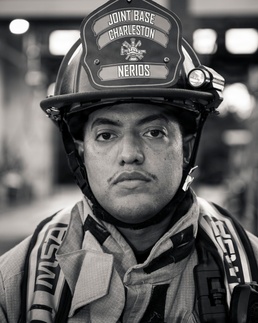
JOINT BASE LINDSEY GRAHAM, S.C. — Fluorescent lights hummed above the bunk area as boots crossed the floor and muffled conversations drifted in and out around him. The familiar rhythm of the firehouse continued, but he remained still, staring at the ceiling and shifting in his bunk, searching for a position that would ease the pain in his pelvis. Around him, firefighters came and went, preparing for another day of deployment. The room carried the faint smell of sweat and freshly brewed coffee.
His teammates had seen him push through pain before. They watched him take round after round of antibiotics, manage recurring infections and continue showing up for work. But that day, they could tell he was struggling more than usual.
One of the firefighters told him he should consider going home. He lay there, thinking about everything it took to get him there in the first place.
U.S. Air Force Senior Airman Marshall Nerios joined the Air Force Sept. 6, 2022. Roughly a year later, he was diagnosed with Stage 2 testicular cancer.
“It didn't feel real. I didn't really know how to react,” Nerios said.
On Oct. 30, 2023, Nerios underwent surgery to remove the tumor. The cancer was gone, but recovery did not go as expected. Two undissolvable stitches remained from the procedure, and part of the incision failed to close.
Multiple CT scans, MRIs and ultrasounds followed as doctors searched for an explanation. The tests continued, but so did the pain and infections, leaving Nerios without a clear answer for what was happening inside his body.
Nerios was tasked to deploy to Ali Al Salem Air Base, Kuwait, in October 2024. Because of his medical history, he was considered a higher risk candidate and needed a waiver to go.
“I wanted to prove to myself that I could do it,” Nerios said. “That mentally, I was stronger than what my body was going through.”
Despite repeated treatment, the infections continued after Nerios arrived in Kuwait.
Nerios went through four rounds of antibiotics during the deployment, sometimes finishing one course only to need another. His biggest concern was preventing an infection from becoming serious enough to turn septic.
The gym became one of the few places Nerios could control. Treadmills hummed beneath his feet while weights clanged against the racks around him. He moved from cardio to strength training and back again, sweat building along his forehead as the minutes stretched toward two hours. His body hurt, but the numbers in front of him were easier to understand than the questions surrounding his health. He could count the miles. He could count the repetitions. He could control the next one.
But there were days when even distraction wasn't enough.
Nerios shifted onto his side, trying to find a position that didn't hurt. He rolled onto his back. Then his other side. Nothing worked. Around him, the room carried on. Boots crossed the floor, lockers opened and closed, and voices echoed through the firehouse. Nerios stayed in his bunk, waiting for the pain to ease enough to get up.
It didn't.
“I just spent the whole day sleeping,” Nerios said. “I was having pain, and I felt like I was giving up.”
His roommates noticed and encouraged him to talk to leadership and consider going home. His medical problems had become serious enough that, while still deployed, doctors discussed sending him to Germany for emergency surgery to determine what was happening.
Nerios listened, but he wasn't ready to leave. He begged for the deployment. Going home would feel like proving the doubts surrounding his medical history right and letting down the leaders who trusted him with the opportunity.
“I didn't want them to be like, ‘See, we told you,’” he said. “I didn't want to let my leadership down.”
But his teammates saw what it was costing him.
“It's a small family,” Nerios said. “If it wasn't for the people I was with, I mean, I don't know.”
After completing the deployment, Nerios returned to Charleston, where he continued follow-up care for complications from his surgery. Eventually, the infections and complications subsided, but the experience stayed with him. The things he spent months missing were waiting for him.
“I came back and I was happy, but I wasn't overjoyed as I thought I would be,” Nerios said. “I started asking myself, ‘Why am I not appreciating the little things right now?’”
For years, Nerios approached problems with the same instinct: find the problem, figure out a solution and fix it.
That mindset served him well as a firefighter, but it also made it difficult for him to admit when he needed help.
When the deployment ended and the distractions disappeared, drinking became one of the ways he tried to quiet the weight of what he had been through.
“I told myself, ‘I'll just start off small,’” Nerios said.
He couldn't.
“I’ve been told that’s one of my problems. I try to fix everything, even when it’s not mine to fix. Sometimes, things just can’t be fixed.”
Eventually, Nerios reached a point where he knew he could not navigate it alone.
On July 8, 2025, Nerios checked himself into the Alcohol and Drug Abuse Prevention and Treatment program, an Air Force resource for Airmen struggling with alcohol or substance use. He also began working with a therapist.
Six months of sobriety gave him something he had not expected: perspective.
Sobriety did not make everything disappear. It forced him to confront what remained.
For the first time, Nerios was learning that strength could also mean taking care of himself.
“I need to start doing things for myself,” Nerios said. “I was doing this for this person, I'm doing it for that person. I put myself aside for so long.”
He began spending more time with family and friends and finding reasons to leave the house. Sometimes, that meant going to the beach and sitting near the water, watching the waves roll in and recede along the shore. He didn't need to do anything. He just sat there and watched the water.
“I feel like I'm finally starting to breathe a little bit,” Nerios said. “I'm starting to appreciate the little things in life.”
“Being a firefighter has made me realize and embrace that it’s just my nature,” Nerios said. “I was destined to be out there assisting the community, making the world a better place, one bandage at a time, one blood pressure cuff at a time.”
But caring for people no longer meant simply responding when someone needed him. Sometimes, it meant recognizing when the person beside him needed help.
Nerios now encourages the firefighters around him to seek help when they need it.
“It really does put a strain on you, so I tell all of them, just go speak to somebody, he said.”
When asked what he would tell someone who might recognize themselves in his story, Nerios paused.
His thumbs, which had moved anxiously throughout the interview, became still. He stared off into the distance, taking several seconds before answering.
“Put that pride aside,” Nerios said. “For some reason, it's just hard for us to do it, but putting that pride aside, it's not about crying or proving how manly you are. You can just be vulnerable for a second.”
He knows what can happen when someone waits.
He waited after his cancer diagnosis. He waited through the deployment. He waited until he came home.
“I wish I would have done it sooner,” he said. “After my diagnosis with cancer, I could have gotten help, but I decided to wait until after my deployment.”
And now, he measures progress differently.
“Even if it's 1 percent or half a percent every day that you're getting better, eventually down the road, you're going to get close to 100 percent,” Nerios said. “It's just one day at a time. Even if it's five steps forward, three steps back, you're still moving forward.”
The fluorescent lights still hum above the firehouse. Boots still cross the floor. Coffee still brews somewhere nearby as firefighters wait for the next call.
The room is familiar.
So is the work.
But Nerios is different.
He stopped asking himself, “Why me?” and started asking, “What’s next?”
For the first time in a long time, he is looking forward to finding out.
And for the first time in a long time, Nerios knows how to stand.