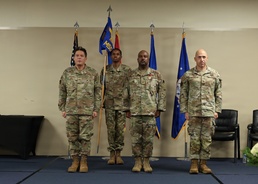
As Col. Lionel Riley prepares to hand over command of the 188th Wing’s Mission Support Group to Col. Michael Krom on Sept. 13, 2026, he does not view the transition as moving away from Ebbing Air National Guard Base.
“I’m not really looking at it as moving away from the 188th as much as moving into the next chapter of service and leadership,” Riley said.
Riley’s perspective on leadership has been shaped by a career that began in the Army as an infantryman and later combat medic before continuing in the Air National Guard. Along the way, he has served as an enlisted Soldier, officer, chief human resources officer and business owner.
Each chapter, he said, prepared him for a different aspect of leadership.
“My military career started very differently than it looks today,” Riley said. “I learned very early that leadership isn't about your rank. It’s about whether people trust you when things get difficult.”
That lesson followed him through a variety of Air National Guard leadership assignments, including positions in Services, Equal Opportunity, and the Intelligence, Surveillance and Reconnaissance Group.
“People execute the mission,” Riley said. “My job as a commander was to give them clarity, remove obstacles and hold the standard.”
That philosophy became especially important when he stepped into command of the Mission Support Group, whose reach extends far beyond the organizational chart. With civil engineering, communications, logistics, security forces, force support and contracting under its umbrella, the group touches nearly every aspect of an installation’s daily operations.
“You get to know people—their families, their aspirations, their challenges, what motivates them—and suddenly every decision has a face attached to it,” Riley said.
That personal connection became one of the defining characteristics of Riley’s command.
During his command, the group persevered through increased operational demands, competing priorities and resource constraints. However, the accomplishment he is most proud of is not a single event or initiative. It is the team and culture he believes the Mission Support Group built together.
“I truly believe the organization is stronger, more connected and better positioned for the future than when I took command,” he said. “If we do our jobs well, other people can do theirs.”
That same philosophy shapes the advice Riley offers to the next generation of Air Force leaders: be curious, be humble and learn their people before trying to lead them. He also emphasizes that leadership is built on more than position.
“Your rank will give you authority, but your character and relationships determine whether people want to follow you,” he said.
As he prepares to leave the Mission Support Group, the thing Riley expects to miss most is also the thing he considers most important.
The people.
He will miss the Airmen who show up every day and make things happen, the squadron commanders, chiefs, first sergeants and supervisors who challenged and supported him, and the stories of professional, educational and family accomplishments shared by the wing’s drilling-status Guardsmen.
But most of all, he will miss the moments when a problem appeared impossible and the team found a way through it.
“The MSG taught me that resilience isn't an organizational slogan,” Riley said. “It’s people. It’s the Airman who shows up when the mission is hard. It’s the leader who finds another way. It’s the team that refuses to let a challenge become an excuse.”