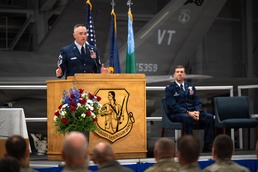
Every morning for nearly 29 years, Chief Master Sgt. Jeffrey L. Steadman has driven toward the same unmistakable Vermont landmark on his way to work: the broad, distinctive profile of Camel’s Hump rising against the sky.
Soon that daily view will belong to someone else.
As the command chief master sergeant of the Vermont Air National Guard’s 158th Fighter Wing, Steadman has spent his career advising wing commanders on everything that touches the enlisted force — organization, training, equipping, morale and the vital work of taking care of Airmen and their families.
Now, with retirement approaching, the dairy farm kid from Addison County who never planned to wear chief stripes is taking stock of a life built on two unshakable priorities: his family and the Green Mountain Boys.
“I grew up on a dairy farm in Addison County,” said Steadman. Coming out of high school in 1997, he knew two things with certainty: he wanted to serve and he did not want to spend his adult life milking cows.
He also knew he wanted to get married and raise kids, goals that ruled out the long sea tours of the Navy he had briefly considered.
The National Guard offered the right blend of meaningful service without constant absences. College money didn’t hurt either.
Then his mother, ever helpful, came home from the Addison County Fair with a business card from an Air National Guard recruiter.
“I’d never heard of the Air Guard,” Steadman recalls, “but that was the number I had, and that’s the number I called. And pretty quickly I was a member here.”
The unit felt right from the first tour. Good people, close to home in Burlington, the kind of environment where a young man from the farm could see himself belonging. He never looked anywhere else.
Steadman chose his first Air Force Specialty Code carefully. He scanned the list for the largest GI Bill kickers, then noticed one that offered EMT training.
“I thought some emergency medical training would be very helpful in my life,” he says. He shipped out in early 1998 for what became an 11-month journey through Basic Military Training and technical school.
After 9/11 he moved to the command post, where he spent 11 years. In 2012 he crossed into supply and logistics work that has remained his primary specialty ever since.
Across three AFSCs and roughly five primary jobs inside the wing, one theme never changed: be the wingman others want on their team.
“As a young NCO I had four children even when I was a staff sergeant,” he recalls. “Family was priority one. Professionally, I just wanted to be someone other Airmen wanted to work with and know they could count on.”
He never spent time imagining himself as a chief master sergeant retiring with decades of service. “It definitely wasn’t on my sheet of things I was thinking about.”
Steadman has deployed five times overseas, with two combat tours to Iraq, one to Saudi Arabia, and theater support packages to Korea and Japan, plus more stateside tours of duty than he can count.
His first trip, still a brand new medical Airman, took him to Wright-Patterson Air Force Base outside of Dayton, Ohio. Active duty staff made an impression on him with the senior NCOs who made sure the young Airmen could always have a reason to laugh. That care, he says, has been the constant on every deployment since.
In Iraq he worked the operations desk as a command post Airman supporting F-16 pilots flying close air support and striking targets. Long flying windows made dining facility hours almost theoretical, so the team hauled 60 or 70 meals back to keep everyone fed.
At Balad the first time, they slept in eight-person tents while mortar attacks were common enough that every returning jet spent half an hour circling the base looking for launch teams before landing.
Asked what it felt like to live under that threat, Steadman said “I often say I must be too stupid to be afraid. It was just like a regular workday, long workdays, but it wasn’t anything I spent time thinking about. It was much more like being worried about winning the lottery. I just didn’t think the chances were that good.”
If there is a single thread that runs brightest through Steadman’s story, it is family. He and his wife have been married 26 years.
They decided early that one of them would stay home with the children when they were small. The Guard made that possible.
“My wife would come in two or three times a week with the kids and just eat lunch with me in the ops building,” he says. “The leadership team made her feel so at home. It’s almost like my kids grew up here. There are literally hallways in Building 70 that my kids helped paint just to spruce things up. Countless Halloween parties and holiday parties. It really made them feel connected to the larger team.”
That support ran both ways. On the day he left for his second Iraq deployment, his wife, who 7 months pregnant with their fourth child, stood in the tower with the three older kids and his mother to watch the jets launch.
Their van got towed. A quick call later, a coworker was there within minutes to take them downtown and get the vehicle out of impound.
“That’s one of the ways the home team has done a great job helping my family out,” said Steadman. He believes the way the Vermont Air Guard treats families is genuinely unique among employers. “A lot of jobs don’t say family first. We do.”
Ask Col. Brian D. Lepine, vice commander of the 158th Fighter Wing, what stands out about Chief Steadman and he smiles at a small detail hanging in the chief’s office: a poster of the “15 Faces of Spock.”
“I actually got that for him,” Lepine says, “because I think he’s steady, he’s solid and you can’t fluster Chief Steadman. I’ve tried a lot over the years, but he is the utmost professional. He always has been. He always will be.”
What impresses Lepine most is Steadman’s integrity. “I’ve never seen anybody who, no matter who’s looking or not looking, is always going to do the right thing.”
That consistency, Lepine believes, helped Steadman fulfill every dream he set for himself as a young man. Marry, raise kids and serve in the Guard.
“How happy am I that he got to fulfill all his life dreams,” said Lepine. “It’s pretty awesome.”
But Steadman’s deepest gift to the organization, according to Lepine, was cultural. Roughly a decade ago, during a professional development conversation about the wing’s climate, Steadman made a stark admission: the wing needed a cultural shift.
“From a guy like him, that means a lot,” Lepine recalls.
Steadman didn’t just diagnose the problem. He worked relentlessly to fix it. From professionalizing the force, mentoring officers and senior enlisted alike on what true senior-enlisted leadership looks like.
“I know for a fact that we’re a better place for his contributions,” said Lepine. “He focused a lot on putting options in front of Airmen but allowing them to choose how their career is going to be.
‘Where do you want to be? Here’s a couple options. I’m not going to do this for you, but if you want to get here, here are the things you should consider.’ He was honest and sincere.
Becoming command chief forced a shift Steadman still finds both challenging and clarifying. As a young Airman, the mission was immediate and tangible — get the parts, feed the pilots, keep the jets flying.
As command chief the horizon stretches months and years ahead: drill schedules for the next fiscal year, reintegration policies for returning deployers, whether a recently returned Airman should face a promotion board or receive a waiver.
“You go out of one meeting that’s very much ‘How do we get more parts to the team downrange?’ and five minutes later roll into a meeting about how we want to stack our drill schedules,” said Steadman.
For Lepine, that strategic view is only half of Steadman’s value. The other half is the trust built over more than a decade of advising commanders at every level.
“A guy like Chief Steadman who has the pulse and knows Airmen and is out there actively engaged can really help you understand, as a senior leader, whether the decisions you’re making benefit the Airmen of the organization, or whether you’re kind of off with your assessment and priorities,” Lepine explains.
“I don’t turn a wheel, I don’t do anything, especially when I go out to the masses, without saying, ‘Hey Chief, can you take a look at this for me?’ Does this message resonate? Is it fair? Is it equitable? Is it transparent?’
A good chief like him will always steer you in the right direction and validate the things you’re doing. Ninety-five percent of the time we’re going to agree, but it’s that validation. He validates that my thoughts are the right thoughts and we’re together as a command team. That’s a thing of beauty.”
The advice Steadman himself offers the next generation is simple and fierce. He steals a line from Vermont National Guard Senior Enlisted Leader Command Sgt. Maj. Meyers: “Don’t be mediocre. There’s a lot of mediocre in the world and we don’t need that here. Just be the absolute best that you can be at your job, as an Airman, as a wingman and you’ll be very pleased with the results.”
To his younger self he would add one more piece of hard won wisdom, borrowed from a former wing commander: “We’re 51% stakeholders in our own careers. It was very easy to think if I do a good job and work hard, everything else will take care of itself. You have to have an idea of where you want things to go so you can take advantage of opportunities—and make sure your supervisor knows.”
The view of Camel’s Hump will be one quiet loss. The larger one is the people.
“After 29 years here, this is where all of my friends and what feels much more like brothers and sisters, live and work,” said Steadman. “I will miss that aspect the most. The friendships I’ve built here, getting to meet new people and the amazing things that we do.”
He believes a meaningful life requires serving a higher purpose. The Air Force and especially the Air National Guard, delivered that in a way few other organizations can.
He will miss being part of a unit recognized around the country and the world as a premier fighter wing - the first in the Air National Guard to fly F-35A Lightning II - and knowing the work mattered to the larger team and the nation.
Asked what he would tell someone still on the fence about joining the 158th Fighter Wing, Steadman does not hesitate.
“You should absolutely do it and you won’t regret it. It is the second best decision in my life, the first one being my wife. It has absolutely helped give me a wonderful life, a lot of professional happiness, personal growth. I would absolutely do this again.”