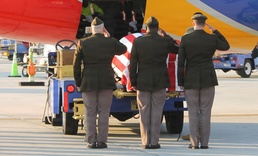
A World War II pilot who went missing in action over Italy in 1943 has finally been laid to rest in his native Harford County, Maryland. The solemn return of U.S. Army Air Forces 1st Lt. Walter R. Bateman was made possible by the exhaustive recovery efforts of the Defense POW/MIA Accounting Agency, the seamless teamwork of Army casualty officers from North Carolina to Maryland, and an overwhelming display of local honor.
Bateman, who was 22 years old when his B-24D Liberator, "Suzy Q," was shot down on August 16, 1943, was accounted for on May 29, 2026. Because his nearest living family members reside out of state, active-duty soldiers and hundreds of local Maryland citizens stepped forward to serve as his surrogate family during his emotional return to Maryland on August 28, 2026.
The Army's Casualty Assistance Center at Fort George G. Meade, Maryland, coordinated the multi-state support. U.S. Army Capt. Jenelle Smith, a licensed clinical social worker with the 44th Medical Brigade at Fort Bragg, North Carolina, was assigned as the primary Casualty Assistance Officer, or CAO, for Bateman’s niece, Mrs. Hannum, and her husband.
When Smith first met the Hannums, who had recently relocated from Washington State, she connected with them immediately over shared memories of the Pacific Northwest.
"We connected right away over shared memories of farmers’ markets and the community they had called home for decades," said Smith. "They were immediately inviting and patient."
For Smith, guiding a family through a repatriation more than eight decades after the loss required a unique, supportive touch.
"The family was moved that the Army continued to honor 1st Lt. Bateman after all these years, and eager to share their family’s history," said Smith. "My role was simply to give Mrs. Hannum time and space to reflect whenever a memory surfaced. In our two months together, I would listen patiently as she relayed stories passed down about that time of her life."
Because the family could not travel to Maryland for the planeside arrival, U.S. Army Capt. Joseph Chestnut III had the solemn duty of serving as the official escort for Bateman’s remains. For Chestnut, wearing the Army's modern Army Green Service Uniform, which mirrors the World War II-era service uniform, bridged the 83-year history.
"To me, the mission to escort 1st Lt. Bateman back home is my way of recognizing the past sacrifices of my brothers and sisters in arms who came before me," said Chestnut. "It is proof that even when a service member is gone, they are never truly forgotten, not by their family, their community, or their nation. It is a deeply fulfilling experience to be a part of this final act of gratitude to Walter Bateman's service, and it demonstrates to those that enter the Armed Forces and their families that no sacrifice will ever be taken for granted."
The homecoming began at the Baltimore/Washington International Thurgood Marshall Airport on August 28, 2026, where the airport came to a standstill as the tarmac transfer took place. The BWI Fire and Rescue Department created a water-cannon arch to salute the fallen airman, while local veterans and active-duty personnel stood in formation.
U.S. Army Maj. John Koehler, chief of the Tri-Service Vision Conservation and Readiness Branch at the Defense Health Agency Public Health-Aberdeen, stepped in as the local courtesy CAO to manage the Maryland-based honors. He described the tarmac atmosphere as "somber, reverent, and deeply respectful."
From BWI, a massive motorcade of approximately 30 Patriot Guard Riders and 30 motorcycle police officers and sheriff's deputies escorted the casket to the Schimunek Funeral Home in Bel Air, Maryland. . Local fire departments and citizens lined highway overpasses to salute.
When the motorcade arrived in Bel Air, several hundred members of the community had gathered with flags and welcome-home signs. For both Chestnut and Koehler, the turn into the funeral home was the most unforgettable moment of the mission.
"Almost a hundred people had gathered there to welcome 1st Lt. Bateman back home, from young children to elders, all from different walks of life, many of whom also serve their nation and their communities," said Chestnut. "The anticipation and the reverence that I saw on their faces as the hearse I traveled on came to a stop was a deeply fulfilling moment for me, something that will stick with me not only during the rest of my career but the rest of my life."
The historical significance of the repatriation inspired immediate community action. Working through APG social networks, Koehler connected with the Jarrettsville VFW, who volunteered to build a custom shadowbox and mount Bateman's newly issued awards from Army Human Resources Command with less than 48 hours’ notice. Bateman was laid to rest with full military honors on Sunday, September 6, 2026, during a private family service at Union Chapel United Methodist Church in Joppa, Maryland. He was buried alongside his parents in the church’s cemetery, where many of his ancestors are interred.
"They were impressed with the level of coordination at every step, and appreciative of the continued efforts of the Army to bring 1st Lt. Bateman home," said Koehler. Though Mrs. Hannum, in her 80s, never had the chance to meet her uncle, the repatriation brought long-sought resolution.
"Many sacrifices are expected not only of service members but also their families: missed birthdays, lonely nights, an empty seat at the dinner table," said Chestnut. "It is a debt that can never be fully repaid by the nation, especially when the service member that family sent to serve their duty gives the ultimate sacrifice, but they all deserve closure at the very least, and I think it is incumbent upon all members of the Armed Forces and the United States Government to do their utmost to provide those families with the closure they deserve." Smith noted that the joint teamwork among the CAOs was completely seamless and that the Hannum family praised the incredible coordination at every step.
"The assignment gave me profound respect for the people working behind the scenes whose dedication I had never fully realized; the intricate history, meticulous recordkeeping, and honors involved were remarkable," said Smith. "Knowing that personnel stand ready to honor a fallen service member decades later, with the same care given to those lost today, was humbling.”
Koehler agreed, noting how the young face in Bateman's WWII portrait bridged the generations. "The photos in his dress uniform contrasted with our modern AGSU made the time gap feel much more immediate for me, as if he could have been any of the lieutenants participating in the welcome home," said Koehler. "The way so many came together to welcome him home across all Services, veterans of conflicts past, family, and community reinforced why I serve this great Nation."
NOTE: The mention of any non-federal entity and/or its products is for informational purposes only, and is not to be construed or interpreted, in any manner, as federal endorsement of that non-federal entity or its products.