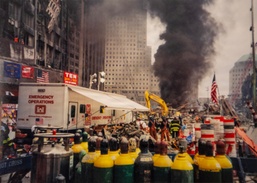
OMAHA, Neb. – The scale of destruction left by the attacks on Sept. 11, 2001, was difficult for anyone to comprehend. Those who were at Ground Zero witnessed indescribable devastation. But they also witnessed the strength of the people who kept working amongst it – and the bonds formed by those who came together to help.
The following accounts are from Pam Eckerman and Cheryl Specketer who deployed to Ground Zero along with five other U.S. Army Corps of Engineers, Omaha District employees to support search and recovery efforts. These firsthand experiences were recorded in December 2001 and are highlighted again today as part of a short series in recognition of the 25th anniversary of the September 11th attacks. The attacks claimed 2,977 victims and required one of the largest disaster response efforts in U.S. history.
Eckerman worked nights at the Liberty Command Post, assisting firefighters and supporting operations at Ground Zero while Specketer worked directly with Federal Emergency Management Agency personnel, providing administrative support and maintaining accountability for FEMA-owned and leased assets.
“Utter devastation”
Eckerman left Omaha at noon Sept. 17, 2001, departing from Offutt Air Force Base aboard a small, 10-seat USACE aircraft belonging to the Northwestern Division.
The skies were startlingly empty.
After arriving at their hotel late that night, she and the other team members had only a few hours to sleep before meeting again at 5 a.m. The group left for Ground Zero, arriving shortly after 6:30 a.m. on Sept. 18, 2001.
“The sun was just beginning to brighten the sky overhead – but down below there was utter devastation,” Eckerman wrote in her original account. “They say a picture paints a thousand words – but my first view of ‘Ground Zero’ was so incomprehensible, I’m not sure a picture would do it justice.”
Everything was covered in fine gray dust. Around her, search and rescue teams from the New York Fire and Police Departments, along with construction and steel workers, the Salvation Army and the Red Cross were all working. Eckerman described the effort as “a finely orchestrated production.”
She was assigned to the night shift at the Liberty Command Post, working from 7 p.m. to 7 a.m. each day. After arriving at Ground Zero, she and her fellow workers moved through checkpoints guarded by NYPD officers, navigating around dump trucks, cranes and an overwhelming amount of debris.
The Liberty Deployable Tactical Operations System, or DTOS, trailer became their base. Inside were telephones, a copy machine, fax machine, microwave, coffee machine, water cooler and chairs - equipment that provided a small measure of organization and support amid the destruction.
Outside, FDNY members waited for their opportunity to return to the debris.
“They would sit and stare at the debris in despair, as if by force of will they could change the course of events to a more positive vein,” Eckerman wrote.
Her first night, she was assigned to guard the trailer and assist FDNY in whatever way she could.
Much of the time, there was little to do but watch.
What she saw was unlike anything she had experienced.
Instead of the familiar office furniture, computers, carpet and concrete she might have expected to find in the remains of two enormous office buildings, the debris was dominated by steel pillars and wires. Some pillars rose as high as 20 stories. Smaller girders lay scattered across the site.
Everything was covered in the same gritty, fine gray dust.
Smoke rose from numerous places. Heavy machinery filled the air with noise. Search and rescue workers moved with dogs. Medical personnel and volunteers worked throughout the site. Salvation Army and Red Cross volunteers delivered food and water.
“Everywhere you looked there were workers,” Eckerman recalled. “The level of commitment and dedication displayed by all the many workers was incredible.”
A ritual of gratitude
Amid the destruction, Eckerman also remembers the people of New York.
Each evening, the night crew traveled to Ground Zero through a special lane reserved for rescue workers. Along the way, citizens stood on the streets holding signs and waving.
“During the days to come – rain or shine, warm or cold - I would witness this ritual on a regular basis and come to appreciate those special citizens and their dedicated tributes.”
The gestures became part of the rhythm of each day.
“Every day we honked and waved to the citizens who waved their thank you signs – it became an important part of our day.”
Those moments of gratitude stood in sharp contrast to the conditions at Ground Zero, where workers put in long hours and returned day after day to an extraordinarily difficult and dangerous environment.
Eckerman was struck by the commitment of the firefighters and other responders, who continued working despite exhaustion and the conditions around them.
One moment in particular made the danger unmistakable.
The day before she left, more than two weeks after the attacks, a 300-ton crane pulled a steel girder from the rubble. The girder glowed bright red. Liquid metal dripped from it, and flames shot from the hole left in the debris.
“This, more than anything, brought home to me how very dangerous this rescue/recovery mission was for all those workers who consistently worked up on the pile, never once complaining.”
She also came to understand why FDNY workers had to replace their boots repeatedly.
“The soles had simply melted off.”
“Teams form bonds”
Specketer arrived in New York on Sept. 17 as part of the effort supporting the USACE-owned DTOS units deployed to support New York City, FDNY and FEMA.
She and Tami Robison of the Portland District worked directly for FEMA personnel operating from one of the DTOS units at Ground Zero.
Their responsibilities included maintaining property accountability for FEMA-owned or leased assets and providing administrative assistance to as many as six FEMA personnel coordinating response efforts with FDNY and other federal agencies.
This was Specketer's third disaster response mission. Leaving her family was not difficult, she recalled, because she was consumed by a feeling of honor at being able to go to New York and help.
Her family, she said, was “100 percent supportive” before, during and after the deployment. For Specketer, the most lasting part of the experience was the people.
“The most important thing I took away from this response effort was the friendships I made.”
She had worked with some members of the team during previous disaster responses, creating a foundation of trust before they ever arrived in New York.
“Each time I am deployed with this team, I feel a stronger ‘bond’ with each and every one of them,” she wrote. “But this time was different; I think it was due to the circumstances - everyone was very, very close.”
That closeness extended beyond the USACE team. Specketer remembered watching FDNY and search and rescue workers change shifts, seeing one group leave while another took its place.
“It was totally awesome and amazing - like a major force that had one mission in mind.”
She was deeply affected by the determination of those workers.
“The determination and love (and pain) in these individuals’ eyes will never leave my mind or my heart.”
A shared sense of purpose
Although Eckerman and Specketer performed different jobs, their accounts reveal the same underlying experience: Ground Zero was a place where people from different organizations and backgrounds came together with a common purpose.
Eckerman saw that cooperation firsthand as the FDNY, NYPD, Port Authority Police Department, search and rescue teams, construction workers, volunteers and others worked side by side.
She recalled that the FDNY was initially reluctant to ask for USACE assistance but eventually came to depend on it. “We formed bonds with our fellow night workers and fellow FDNY, NYPD, and PAPD personnel,” Eckerman wrote, describing friendships she said they would “remember and treasure.”
Specketer saw that same spirit from within the response organization.
“I also hold great pride in the ability of so many people to come together and work together as though they had known each other for years in support of our nation,” she wrote.
She remembered a caring group of USACE personnel who supported one another every day, strengthened by relationships developed during previous disaster responses.
That sense of connection extended beyond the immediate response team. During the deployment, Specketer encountered a number of prominent visitors, including FEMA Director Joe Allbaugh, former President Bill Clinton, Army and USACE senior leaders, and others who came to Ground Zero.
But those encounters were not what she considered the defining moments of the mission.
The defining moments were the people doing the work.
“Your Grandma was there”
For Eckerman, the experience of Ground Zero remains one she expects to carry with her for the rest of her life. She remembers the sights, the sounds, the dust, the smoke and the exhausting work. She remembers the citizens holding thank-you signs and the firefighters waiting for their next opportunity to search the debris.
And she remembers the feeling of being part of something much larger than herself.
“There is one thing I’m sure of - I’ll always be grateful that I was able to render aid in this emergency, becoming a part of a truly tragic historical event - even if it was only in a small way.”
For Specketer, the lasting memory is similarly personal - the friendships, teamwork and shared commitment forged during an extraordinary moment in American history.
Twenty-five years later, their accounts offer a glimpse into what it meant to be there: to arrive in a city still reeling from unimaginable loss, to work long hours in difficult conditions, to support those leading the recovery and to stand alongside people determined to keep going.
For Eckerman, it is a story she knows she will one day tell her grandchildren.
“This episode in my life will surely become one of those stories I can amaze my grandchildren with – yes, your Grandma was there!”