VOLK FIELD AIR NATIONAL GUARD BASE, Wis. — Kentucky Army National Guard Soldiers strengthened their aviation and emergency response capabilities during Patriot 2026, a large-scale joint disaster response exercise in Wisconsin, Aug. 24-31.
The exercise involved approximately 1,000 Soldiers and Airmen from National Guard units representing 35 states, along with federal, state and local emergency response partners, at Volk Field Combat Readiness Training Center and Fort McCoy.
Patriot 2026 simulated a large-scale natural disaster requiring an Emergency Management Assistance Compact response. The Kentucky National Guard aviation element, made up of aviators assigned to Charlie Company, 1st Battalion, 376th Aviation Regiment and 751st Troop Command, 63rd Theater Aviation Brigade, logged 129.5 flight hours while conducting missions designed to prepare crews for domestic emergencies and future operations.
The exercise allowed Kentucky aviators to operate alongside Army, Air Force and civilian partners while working under a joint emergency operations center.
"This exercise put our Soldiers and leaders into an environment where they had to deploy, establish aviation operations and execute missions just as they would during a real domestic emergency," said U.S. Army Lt. Col. Joseph Snoke, commander of the 751st Troop Command. "We were able to integrate with the Air Force, local agencies and other National Guard units while conducting realistic missions that directly improve our readiness."
Throughout the exercise, the aviators executed a wide range of missions, including search and rescue, medical evacuation, casualty evacuation, aerial surveillance, personnel transport, cargo movement and convoy security. Aircrews also worked alongside Air Force medical personnel to practice litter-loading procedures and supported law enforcement with aerial observation and target tracking during simulated emergency response scenarios.
U.S. Army Capt. Patrick Carlisle, commander of Headquarters and Headquarters Detachment, 751st Troop Command, noted the value of training in an unfamiliar environment.
"The training area is very unique," Carlisle said. "A lot of the landing zones are extremely tight and require pinnacle landings, things we don't normally get to do in Kentucky. We've flown just about every mission the Lakota is capable of, and it's been an outstanding opportunity to work alongside the Air Force and other partners."
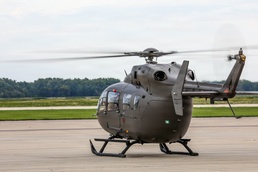
The UH-72 Lakota operated as a multi-role platform throughout the exercise. Crews used the aircraft to locate stranded victims, conduct aerial surveillance, transport personnel and provide real-time information to responders on the ground. Its camera systems gave emergency managers additional situational awareness before ground forces entered affected areas.
For many Soldiers, Patriot 2026 also marked their first major joint-environment training outside of the commonwealth.
"Our goal was to expose our new pilots and crew chiefs to missions in a completely different environment," said U.S. Army Sgt. 1st Class Shawn Firkins, acting standardization instructor for Kentucky's UH-72 crew chiefs. "Working with the Air Force, law enforcement and other agencies gave our Soldiers experience they simply can't get during routine training at home."
The training operations heavily featured confined-area landings, rescue missions and aerial surveillance.
"I think our Soldiers are much better prepared moving forward," Firkins said. "Now they have experience to build on, ask better questions and improve future training."
Beyond flight operations, Patriot 2026 gave the command’s staff its first opportunity to coordinate aircraft movements, track missions in real time, and manage communications from an unfamiliar location while supporting multiple agencies simultaneously.
"One of the biggest takeaways was seeing our battalion staff deploy and build aviation operations away from home station," Snoke said. "Our staff gained valuable experience with battle tracking, mission management and operating in an austere environment while supporting real-time operations. Those are experiences we can't fully replicate during routine training."
The exercise also strengthened partnerships across the military and civilian emergency response community. Kentucky Soldiers worked alongside Air National Guard units, local law enforcement, emergency medical personnel and industry partners, reinforcing the coordination required during large-scale disasters.
"This exercise allowed us to validate our deployment processes, exercise our staff and execute real-world aviation missions in a joint environment," Snoke said. "Every mission made us better prepared to support our communities and respond wherever we're needed."