Vice Adm. Michael L. Cowan (1944-2023) served in a wide-variety of clinical, operational, staff and leadership positions over the course of his 33-year career. His career culminated in 2001 with his selection as the 34th Surgeon General of the U.S. Navy and Chief of the Bureau of Medicine and Surgery (BUMED).
Cowan was only thirty days into his tenure as Surgeon General when the attacks on September 11 took place. Instantly, the world had changed, and Navy Medicine’s course would forever be altered to meet the new challenges ahead.
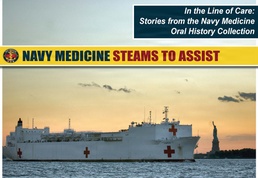
Years after leaving office, Vice Adm. Cowan shared his reflections about the day and his decision to deploy the Military Sealift Command hospital ship USNS Comfort (T-AH 20) to New York City where it served as a sanctuary for thousands of beleaguered rescue workers and helped buoy the nation during one of its most trying moments.
The following is a brief excerpt of this oral history session.
***
“When I showed up on August 10 and looked around, my first thought was, ‘Man, don’t let me screw this up.’ Things were working quite well. We were adequately funded and there were good people in place at all the key positions. My predecessor Vice. Adm. Richard Nelson had done a nice job, which is the best way to go into a command, I think. Everybody thinks they want to go into a command that’s really a mess so that they can clean it up. I want to go into a command that’s working well so I can take it to the next level. I thought, ‘This is really good. I’ve got some things I want to do, so let me take 30 days.’
I decided I’d take 30 days and come up with eight to 10 priorities that would drive my time as Surgeon General. So, on September 10, 2001, I finished those priorities. As I recall, that was a Monday. On September 11, I walked back to my desk about 10:30 in the morning and threw them in the trash can. Priorities had just changed. The first thing I did on September 11 was send all non-essential people and personnel home. The second thing I did was walk out to the [signal] flags, which until then, the Navy Medicine motto had been: ‘Charlie Golf One – Standing by to Assist.’ I changed them. I said, ‘You haul those flags down and you change them to: ‘Charlie Papa – Steaming to Assist’ immediately. We flew those new flags that day.
***
I got a call from the emergency management center in New York City, and they said, ‘We’re trashed. We think that we’re going to be medically overwhelmed. There are rescuers running all over the place that are injured. The two towers came down, and we think that we need help. Can you send the Comfort?’ We launched the Comfort. The next day, he called back and said, “We just realized that our situation is not what we thought it was. What we’ve got is, if you were in the building, you died. If you were out of the building, you lived, and there aren’t very many injuries. So medically, we were not overwhelmed, but we are overwhelmed with humanity. The island doesn’t have facilities. We’ve got firemen and rescuers and police digging through the rubble and sleeping on the hood of their engines; they’re going to be dirty and filthy; there’s no food. There’s no way to feed them, no way to get water to them, but if you can bring the Comfort as the “Comfort Inn,” we could really use the facility on the island. We can dock it very close, and it would be tremendously helpful to the city.’
When the Comfort had gotten out of the Chesapeake [Bay in Virginia] and was coming up to Earle, New Jersey, I got a call from the skipper, Capt. Charkes Blankenship of the hospital onboard. He said, ‘Okay, the mission has changed. We’re rigged and manned and equipped for high intensity surgery. How do I change our mission?’
I said, ‘Okay, pretend this is your new mission. You’re going up to New York to be the team doctor for an international, middle-aged, out-of-shape men’s rugby tournament.’
He said, ‘I got it.’
So, they got to Earle, New Jersey, and they had what they called an ‘abandoned ship drill with duffle bags.’ The surgically intensive team abandoned ship. Primary care and physical therapy and messmen and general duty corpsmen boarded, and they steamed up to New York. They provided up to 1,000 people a day: hot meals, a shower, a berth, and laundry service. So, you’d go aboard, they’d take your dirty laundry, feed you, put you to bed, give you a shower, wake you up, give you your clean clothes back, or new clothes, and send you back to work. We took criticism for that. There were people who thought that that was an undignified mission for a war ship of the United States Navy and I shouldn’t have done that.
The Comfort stayed until rescue was over, and then it was recovery, or much less intense, and the Comfort came back home.
A year later there was a Baltic exercise where European and East European medical officers, as well as our folks, were supporting Baltic ops, and there was a reception for one of the princesses of the British Royal family, so I needed to go for protocol purposes. I went over for this reception and got to review the ship. And after the reception, which was up on the deck, I walked over to where the messmen were and to congratulate them for a nice job. As we were talking and laughing and I said, ‘By the way, how many of you were on the Comfort last year?’ And most of the hands went up. This one kid, a 22-year-old, kept trying to put his hand up and the others kept slapping him down, good naturedly, but as if saying ‘you don’t count.’
I said, ‘Come here. Were you aboard the ship last year?’
He said, ‘I was on the Comfort in New York, but I wasn’t crew. I was a New York City fireman. After New York I was so impressed that I joined the Navy under the condition that I become a messman assigned to the Comfort.’”
***
The Navy Medicine Oral History Project was started by the BUMED Historian in the 1980s as a means of capturing the stories and important experiences of the men and women of Navy Medicine, both past and present. Future installments of the “In the Line of Care” series will feature some of these stories captured over the years.
SOURCE: Cowan, Michael, Vice Adm., Ret. (Oral History by A.B. Sobocinski and Ret. Col. Richard Ginn, Sept. 12, 2013. BUMED Oral History Collection.