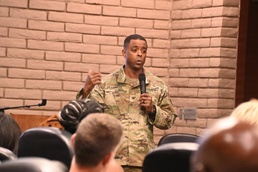
U.S. Army Yuma Proving Ground leaders from all areas of operations across the enterprise, from the Arctic to the Tropics, gathered on Sept. 9 to talk about the future and change.
The occasion was a wide-ranging muti-hour strategic collaboration at the post’s Palm Garden Conference Center held by YPG Commander Col. Charles Seaberry.
The strategic meeting established a Command Operating System to shift the organization to more rapidly actionable understanding through disciplined communication, decentralized leadership, and clear accountability. Disciplined communication, Seaberry emphasized, is vital to give a commander rapidly actionable information across all YPG’s commodity areas at each of YPG’s natural environment test centers.
“It is a challenge to understand every single thing we do,” said Seaberry. “I want the ability to see it all and need data. I want to be able to see it and comprehend it.”
The Common Operating System is grounded in three guiding principles: precision, purpose, and people. These principles emphasize accurate data, direct alignment to Warfighter needs, and empowerment of the workforce. Seaberry believes purpose is the foundation of the three, observing that YPG testing during the worst days of Iraq and Afghanistan saved the lives and limbs of thousands of American Soldiers. YPG’s current importance at the forefront of counter-unmanned aircraft systems testing continues this vital mission on behalf of the warfighter and American people.
“Purpose is translated at all levels of an organization,” said Seaberry. “We stay away from complacency when we all know our purpose. I think purpose is more impactful when you really know what you’re fighting for.”
To put this philosophy into practice, the command is implementing three core pillars: common lenses, common rhythm, and common ownership. Common lenses provide six standardized perspectives for evaluating operations: mission, people, money, readiness, engagements, and risk. Common rhythm creates a deliberate battle rhythm of update briefs and quarterly reviews designed to support decision-making rather than passive information sharing. Common ownership establishes clear roles and responsibilities across staff sections and test centers through standardized reporting tools.
“I want to preserve everything that works,” said Seaberry. “If it’s not working, we’re going to sharpen it.”
The command is also driving a cultural and operational shift toward a leader-leader model that pushes authority to the lowest competent level. Under this approach, briefers are expected to provide analysis, implications, and recommendations rather than simply reciting information. Communication discipline will be reinforced through structured meetings, concise correspondence, and a dedicated task tracker to ensure every decision has a clearly assigned owner and deadline.
Seaberry intends to hold biannual strategic offsites and challenged attendees to think about what they want to start, stop, and sustain.
“All of you are empowered to talk at the next strategic offsite about what you want to change,” said Seaberry. “This is me getting you to start thinking about this. I work for you.”
As he approached 90 days in command, Seaberry said he has been observing the organization to identify friction points and gain new efficiencies in YPG’s critical mission providing test data on behalf of the nation’s warfighters. He feels confident in the post’s ability to remain at the forefront of Army transformation into the far future.
“A lot of times you get nervous about the skillsets we have at YPG because generally speaking there isn’t a lot of bench to pull individuals from to step up should we get a retirement,” said Seaberry. “I’m extremely impressed at how we are developing our future workforce: If we lose some folks in critical roles to retirement, there are already folks behind them that will be ready to step up. I’ve yet to be part of an organization that does that as well as we are.”