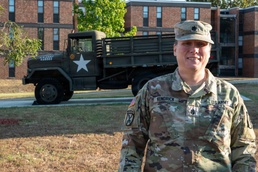
FORT LEONARD WOOD, Mo. — Inspired to act in the aftermath of 9/11, a Fort Leonard Wood Soldier turned national heartbreak into a career of dedicated service.
Before commanding the 58th Transportation Battalion at Fort Leonard Wood, Lt. Col. Julie Kendrick's career in transportation was already underway; on Sept. 11, 2001, she was a 23-year-old college student working for American Eagle airlines.
She went to school during the day while working nights at Killeen Regional Airport in Texas.
“I was getting ready to leave our house for class and I was watching the news when the anchors announced what they thought was an accident in New York. A plane had hit one of the World Trade Center towers,” Kendrick said.
While driving to school, her radio broke the news: a second plane had struck the South Tower.
“I remember thinking that doesn’t sound right. It was complete gridlock in Killeen, and I couldn’t make it through the traffic, so I turned around and went back home,” Kendrick said.
Once home, she turned on the television, watching the devastation unfold.
Describing her colleagues as a tight-knit “unit,” she said she felt an immediate pull to report to work early and stand by them, long before her scheduled shift began.
“I really didn’t know what to do, so I put on my uniform and went to work,” she recalled.
Her duties included assisting with passenger boarding, managing baggage logistics, and ensuring aircraft and tarmac security.
When she arrived at the airport, there was nowhere to park, passengers packed the terminal entrance, and aircraft were grounded along the flightline.
“Everybody there was in a state of shock,” Kendrick said. “American Eagle started working through American Airlines’ protocols.”
American Eagle is the regional brand name owned by American Airlines to operate regional feeder flights connecting mid-sized cities to American Airlines' primary hubs — two of the four planes hijacked on 9/11 were American Airlines flights.
“We had two airplanes on the ground,” she said, and airline staff had to seal plane entrances with tamper-evident tape and enforce around-the-clock physical security on the ramp.
“I felt like I was doing what little I could to help at that time,” Kendrick said.
After the attacks, watching from the tarmac was no longer enough for her. She traded in her airline uniform for U.S. Army camouflage — stepping forward to enlist as a unit supply specialist and fuel the fight from the front lines.
“It was a calling I felt. I had to do my part,” Kendrick said.
By 2003, she was in Kuwait in support of Operation Iraqi Freedom.
“Being there made me feel like I was doing my part,” she said. “I put 100% into doing whatever small part I could to contribute.”
Kendrick said she has felt the calling to serve others for as long as she can remember, rooted in her upbringing on her family’s farm.
“I had a lot of work ethic instilled in me. My parents taught me that success through hard work often takes a team, and I had to do my part,” Kendrick said.
A quarter-century after the attacks, Kendrick stands firmly behind the path she chose.
“I am proud of the decision I made to join.”