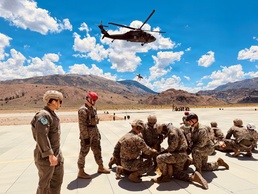
BRIDGEPORT, Calif. — Hospital corpsmen assigned to Navy Medicine Readiness and Training Detachment (NMRTD) Bridgeport strengthened their expeditionary medical skills during air medical evacuation (MEDEVAC) familiarization training with the Marine Corps Mountain Warfare Training Center and Nevada Army National Guard on July 15.
The nine corpsmen from NMRTD Bridgeport and a search and rescue medical technician from Navy Medicine Readiness and Training Unit (NMRTU) China Lake participated in classroom instruction and hands-on helicopter loading and hoisting evolutions designed to familiarize personnel with medical evacuation procedures in mountainous, high-altitude environments.
For Chief Hospital Corpsman Noah Morrison, NMRTD Bridgeport's leading chief petty officer and independent duty corpsman, the training was part of a broader effort to expand operational training opportunities for Sailors assigned to the clinic.
“Since I arrived, my goal has been to find opportunities for our Sailors to train and integrate with the Mountain Medicine training cadre,” said Morrison, who is from Vero Beach, Florida. “As we built our fundamentals through tactical combat casualty care training, we started looking at how we could take those skills further and apply them in a more operational environment.”
That opportunity developed as Bridgeport personnel began coordinating with the Mountain Medicine training cadre to support future training at the Mountain Warfare Training Center.
Morrison said the clinic had previously demonstrated its interest in expanding field medical training by setting up an expeditionary medical tent outside the clinic and conducting an internal mass casualty exercise. He then worked with Mountain Medicine Course leadership to identify opportunities for mutually beneficial training and greater integration.
“Their willingness and support to incorporate us into their air MEDEVAC operations was truly special,” Morrison said.
The collaboration led to plans for Bridgeport personnel to support a future Mountain Medicine final training exercise by establishing a Role 1 casualty receiving location, while also opening the door for the clinic to participate in the July 15 air MEDEVAC and hoist training.
The July 15 evolution began with classroom instruction from a Marine Corps aviation officer covering aircraft and medical evacuation platform capabilities and limitations, including the effects altitude and weather can have on aviation operations.
Participants then moved to the airfield, where two Nevada Army National Guard helicopters were used for hands-on familiarization. Sailors practiced approaching aircraft, responding to aircrew hand and arm signals, loading and unloading patient litters and communicating casualty information to flight medics.
Training progressed to hoist operations, where litter teams worked with mannequins and search-and-rescue medics to practice preparing and securing casualties for aerial extraction.
The mountain environment added considerations not typically encountered during routine clinical duties.
Sailors learned how altitude can affect both aircraft performance and patient care, as well as how terrain, ice, obstacles and aircraft weight can influence helicopter landing zone selection. During hoist evolutions, teams practiced securing litters, attaching tag lines and carabiners, bracing against rotor wash and controlling litter movement during ascent.
“The training gave our Sailors experience with everything from scene safety at a helicopter landing zone and communicating with aircrews to securing patients and conducting casualty reports,” Morrison said. “It also reinforced the medical and aviation considerations that become especially important when you're operating at altitude.”
The evolution also provided an opportunity to train alongside personnel from multiple military organizations, including corpsmen assigned to the Marine Corps, Nevada Army National Guard aircrews and allied nation service members attending mountain warfare training.
For Morrison, that joint environment was particularly valuable for the detachment's junior Sailors.
“It gave our first-term Sailors a physical appreciation for Navy Medicine's role in an operational setting,” Morrison said. “They were able to cross-train and gain experience coordinating not only with greenside corpsmen, but with the Nevada National Guard and allied nation service members as well.”
NMRTD Bridgeport supports personnel assigned to Marine Corps Mountain Warfare Training Center, where the remote location and rugged Sierra Nevada terrain provide a unique environment for medical personnel to develop skills applicable beyond the traditional military treatment facility setting.
Morrison said continued integration with Mountain Warfare Training Center personnel can provide Bridgeport Sailors opportunities to maintain clinical proficiency while developing the tactical medical skills needed to support patients in austere environments.
“This was a solid step in showing the Mountain Medicine training cadre that our personnel are willing to learn and build their tactical medical skills,” Morrison said. “More broadly, experiences like this give our clinic personnel skills they can carry into future operational settings while providing lifesaving support to the warfighter.”
His biggest takeaway, however, was more practical.
“Corpsmen need training to build and sustain their skills,” Morrison said. “Sometimes we allow the daily grind to get in the way of opportunities around us to work on our operational skill sets. We have to continue looking for those opportunities and take advantage of them.”
For Morrison, watching his Sailors train beneath helicopters operating among the mountains reinforced why those opportunities matter.
“I was grinning most of the day watching those helicopters flying above the mountains,” Morrison said. “At one point, I saw a bald eagle gliding in the foreground. It made me incredibly proud to be a small part of America's Navy.”
NMRTD Bridgeport is a detachment of NMRTU China Lake, which is subordinate to Navy Medicine Readiness and Training Command (NMRTC) Twentynine Palms. NMRTC Twentynine Palms supports Navy and Marine Corps lethality by ensuring warfighters are deployment ready and delivering a medically ready, fit-to-fight force prepared to meet operational requirements.
Navy Medicine's 44,000+ talented and ready forces optimize health readiness, deliver quality healthcare, and provide global expeditionary medical support to warfighters.