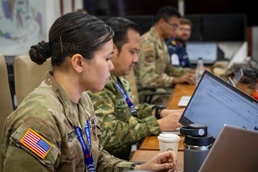
Multinational cyber professionals participating in Super Garuda Shield 2026 tested a more integrated approach to defensive cyber operations Aug. 31 through Sept. 10, 2026 at the Indonesian Armed Forces Staff and Command School in Bandung, Indonesia, through the exercise’s first fully operational Cyber Defensive Operations Center (CDOC).
Now in its third iteration, the cyber exercise (CYBEREX), part of the larger portfolio of exercises that make up Super Garuda Shield, brought together approximately 120 participants from 10 nations, along with additional observers from three nations, to defend simulated networks and critical infrastructure from opposing-force cyber activity.
“This is the first time we’re doing a full integration of a Cyber Defensive Operations Center,” said 1st. Lt. Althea Pittman, Hawaii Army National Guard cyber specialist. “We also have network owners who are playing the part of the site owner, and we also have opposing forces acting as a red cell, basically the adversaries.”
The CDOC served as the command-and-control element for cyber defense teams operating throughout the exercise. From its perch, personnel tracked simulated threats, distributed cyber incident information and coordinated teams responsible for responding to and recovering from attacks.
Though operating from the same buildings on the Indonesian campus, multinational, multiservice cyber teams were notionally deployed to separate areas of a fictitious country. Working from isolated rooms with little direct contact, the teams defended assigned cyber networks under the direction of the CDOC, simulating geographically dispersed operations.
“The Cyber Defensive Operations Center is in charge of the personnel that are forward deployed doing cyber defense operations,” Pittman said. “We do operational control of the personnel and guide them and distribute the cyber incident reports.”
This year’s CYBEREX also expanded the complexity of the virtual cyber range. In coordination with Indonesian partners, planners built scenarios centered on critical infrastructure, including telecommunications networks, energy systems, a solar farm, a power plant and simulated smart cities spread across two fictional islands.
The scenarios were designed to challenge participants with realistic problems requiring both technical expertise and multinational coordination.
“The teamwork has been phenomenal,” Pittman said. “We really wanted to hone in on partner relationships and break through with collaboration, whether it be through different languages or through the products that we build.”
Compared with the previous iteration, the CYBEREX grew in both participation and operational scope. Last year, the CDOC functioned primarily as an exercise-control element responsible for receiving and distributing reports. This year, it became part of the training audience and actively directed defensive cyber operations.
“From last year to this year, we really wanted to do a full integration where we were going to stand up the entire CDOC as part of the training audience,” Pittman said. “From the first planning conference, we had already doubled the amount of participants that were going to play in the cyber exercise this year.”
As the cyber portion of Super Garuda Shield continues to grow, officials are focused on maintaining realistic training while increasing complexity and preserving continuity among participating teams.
Super Garuda Shield is an annual exercise between the Indonesian National Armed Forces andU.S. Military designedto strengthen bilateral interoperability, capabilities, and cooperation. The cyber exercise reflects both the growing role of defensive cyber operations and the enduring Hawaii-Indonesia partnership fostered through the State Partnership Program.