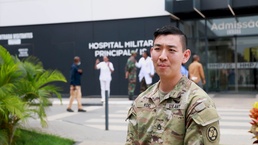
LUANDA, Angola — A medical exchange designed to share military practices became something more when U.S. and Angolan medical professionals found themselves working side by side to stabilize a critically burned patient at Hospital Militar Principal, Sept. 4.
The real-world emergency unfolded during the Angola Medical Readiness Exercise, an initiative designed to enhance the medical readiness and capabilities of U.S. and Angolan military medical personnel. Planned and executed by U.S. Army Southern European Task Force, Africa (SETAF-AF), the MEDREX brought 10 U.S. Army Reserve medical professionals from the 915th Forward Resuscitative Surgical Detachment, 313th Hospital Center, 2nd Medical Brigade, together with Angolan counterparts for clinical collaboration and subject matter expert exchanges.
“At about 2100, we were notified that an unknown burn patient was being transported to the emergency room,” said U.S. Army Staff Sgt. Nicholas Koo, a combat medic and detachment noncommissioned officer in charge with the 915th FRSD. “About 20 to 30 minutes later, a flatbed truck pulled up with a patient who had burns over more than 90% of their body.”
The patient arrived during the team’s planned 24-hour hospital operations. U.S. and Angolan personnel moved the patient from the truck and began resuscitative care, combining their specialties to establish an airway, central venous access and stabilize the patient.
“Everything that we trained for came together,” Koo said. “Our nurses were doing what they were trained to do, our anesthesiologist was managing the airway, and our emergency room doctors and medics were providing emergency care. It was great seeing just how well we worked together in such an emergent situation.”
After stabilizing the patient, Koo and U.S. Army U.S. Army Lt. Col. Matthew Koopmann, general and vascular surgeon, officer in charge of 915th FRSD, coordinated with Angolan medical personnel to facilitate a transfer to a specialized burn center for continued care.
The team’s response drew on months of preparation. During a December battle assembly, the 915th FRSD completed advanced burn life support training at a civilian hospital in Portland, Oregon. The unit also used lessons from a previous MEDREX to deliberately schedule overnight operations after learning that Hospital Militar Principal often experienced increased patient volume at night.
“That preparation became critical when we ended up taking care of a very sick burn patient,” Koopmann said. “We were able to reinforce what we learned during our December burn training and apply it to a real patient, initiate the resuscitation, perform critical procedures, stabilize the patient, and ultimately evacuate them to a specialized burn center.”
For the 915th FRSD, access to real-world patient care also supports readiness requirements that can be difficult to replicate at home. Koopmann said credentialing and privilege limitations often require the unit to train in damage control resuscitation and damage control surgery through simulation in the United States. Embedding with Angolan medical professionals provided opportunities to perform individual critical tasks while strengthening interoperability between the two forces.
Koo’s path to an Angolan emergency room began a decade earlier when he came to the United States from Hong Kong on a student visa. In 2016, he enlisted through the Military Accessions Vital to the National Interest program and began building a career in military medicine.
“I came to the United States on a student visa, but I was blessed to become a United States Army Soldier through that program, and I’ve been serving ever since,” Koo said.
After serving at a combat support hospital, Koo joined the Army Reserve Aviation Command and spent more than four years as a flight paramedic, including a mobilization to Fort Bliss, Texas, and an activation to Malaysia. His military experience complements his civilian career as a paramedic, community paramedic and tactical paramedic with the San Francisco Fire Department.
That aviation background became an asset during a Sept. 8 MEDREX subject matter expert exchange focused on aeromedical evacuation. U.S. and Angolan personnel compared how their forces use rotary- and fixed-wing aircraft to move casualties to higher levels of care.
“Angola is a very large country, so they depend on aircraft, both fixed-wing and rotary-wing, to evacuate injured casualties,” Koo said. “Our platforms may be different, but there were a lot of similarities in our mission of getting patients to a higher level of care.”
Those similarities allowed both forces to exchange practices while examining how different equipment, geography and experience shape medical evacuation.
“We’re able to bring a vast tool set and knowledge set to our Angolan counterparts, and we’re also able to learn a lot from them,” Koo said.
For Koo, MEDREX added another chapter to a journey from international student to U.S. Soldier, flight paramedic and civilian first responder, and provided experience he can carry into both sides of his medical career.
“I may never be able to work in an Angolan emergency room again and bring the knowledge and practices that I’ve learned here back to my civilian life, as well as my Army life,” Koo said.
For U.S. and Angolan medical professionals, the emergency showed the value of MEDREX: building readiness, interoperability, and shared clinical experience before they're needed in the next real-world emergency.