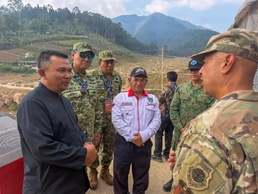
Military members, civilian agencies and international partners came together Aug. 31 to Sept. 4 for a Humanitarian Assistance Disaster Relief Table Top Exercise, or HADR TTX, at the Indonesian Armed Forces Staff and Command School during Super Garuda Shield 26.
The five-day engagement focused on strengthening coordination among organizations involved in disaster response and establishing a common understanding of their respective roles, responsibilities and capabilities.
“The exercise was designed to begin at the local and provincial response level and build to how the respective regional, national, and international response frameworks support current plans,” said U.S. Army Lt. Col. Earl Tsuneyoshi, Hawaii Army National Guard 1st Battalion, 298th Multifunctional Training Regiment commander and planner for the HADR TTX. “This week in particular was to establish that baseline understanding of roles and responsibilities throughout the different phases of a response, but also understanding how each of the different countries do things so that we can collaborate better.”
Super Garuda Shield is an annual exercise between the Indonesian National Armed Forces and U.S. military designed to strengthen bilateral interoperability, capabilities and cooperation.
For the HADR TTX, that concept of interoperability extended beyond military-to-military cooperation. Organizers emphasized a whole-of-society approach designed to improve coordination among military forces, civilian agencies, law enforcement, emergency responders and other organizations that may be called upon during a natural or man-made disaster.
“Whole-of-society government response is necessary to ensure that we have a unified and effective response,” said U.S. Air Force Maj. Maria Ercira Guisadioabis, Hawaii Air National Guard medical plans officer and HADR TTX planner. “Every stakeholder from the national, regional and local levels needs to know what their roles and responsibilities are and how to synchronize their efforts.”
The exercise was structured to move from broad national-level disaster response frameworks toward increasingly regional, provincial and tactical perspectives.
During the early portion of the HADR TTX, participants examined national response frameworks from Indonesia, the United States and partner nations. Later sessions brought in additional organizations and response stakeholders to discuss capabilities, responsibilities and how those organizations interact during disaster operations.
By the final portion of the engagement, discussions had moved toward organizations operating closer to the tactical level, including search-and-rescue and other response assets.
“This first iteration was really about education,” Guisadioabis said. “It was about making sure everyone understood where the different agencies fit and what capabilities they bring.”
The HADR TTX is the first step in a multi-year training approach planners described as “educate, train and demonstrate,” similar to a crawl-walk-run model.
While this first year focused on educating participants and developing a common understanding of disaster-response systems. Future iterations are expected to move into more practical training before culminating in an event where participants demonstrate their ability to coordinate across organizations during a more complex disaster-response scenario.
Part of the long-term intent is to evolve the HADR engagement beyond a tabletop format and into an operational exercise within the broader Super Garuda Shield portfolio, progressively building toward an event that requires participating organizations to apply what they have learned and demonstrate an integrated disaster response.
Planners said the model is also intended to create a repeatable framework that can eventually be adapted to different disaster scenarios and locations throughout Indonesia.
Indonesia already has extensive disaster-response experience and established response systems, but organizers said the engagement provides an opportunity to continually evaluate and improve those systems as conditions, organizations and capabilities change.
“There’s always a feedback loop,” said Guisadioabis. “There are changes in the environment, changes in training and changes in manpower. Even when there’s already an effective system, there are always lessons learned and opportunities to improve.”
Recent disaster-response operations in Indonesia underscored the need for continued coordination among military, civilian and emergency-response agencies. A deadly West Bandung landslide in January 2026, which affected communities in the mountainous region surrounding Bandung and the current wildfires in Kalimantan and Sumatra, also provided real-world examples of the challenges responders face during large-scale disasters.
The HADR TTX also builds upon long-standing cooperation between the Hawaii National Guard and Indonesia through the U.S. Department of War State Partnership Program.
Hawaii and Indonesia have engaged through the program for 20 years, conducting engagements and subject-matter exchanges designed to strengthen relationships, share expertise and improve partner capabilities. Officials said State Partnership Program engagements conducted throughout the year can help sustain momentum between annual Super Garuda Shield exercises and support development of future HADR training.
“What we’re trying to do is synchronize and integrate those efforts,” said Tsuneyoshi. “We don’t want all of these exercises and engagements going in different directions. We want them to be unified and mutually supporting.”
Under that approach, State Partnership Program engagements can provide additional opportunities for Indonesian and Hawaii National Guard personnel to address specific disaster-response topics, exchange lessons learned and prepare for the larger HADR exercise held during Super Garuda Shield.
“It augments the touch points that we have,” Tsuneyoshi said. “Instead of engaging only once a year, the State Partnership Program provides additional opportunities for continuous planning and engagement.”
By creating those relationships and establishing a shared understanding before a disaster occurs, planners said participating organizations can be better positioned to respond collectively when resources, communications and infrastructure may be strained.