Golden Knights Defend Canopy Formation Title at Perris
U.S. Army Parachute Team, the Golden Knights
Date: 09.08.2026
Posted: 09.08.2026 14:41
News ID: 574104
PERRIS, Calif., Sept. 5, 2026 — For two days in the California desert, the Golden Knights flew parachutes into each other, on purpose. Anywhere else in the sky, that is an emergency. At the United States Parachute Association National Skydiving Championships, it is worth a point.
And the Golden Knights scored 168 of them.
The U.S. Army Parachute Team defended its canopy formation 2-way sequential open title Friday at Skydive Perris, winning eight rounds of competition by 62 points.
In 2-way sequential, the event the Golden Knights competed in, DeLand Hard Deck Heros finished second with 106 points. Elsinore Too Wrapped Up and Bad Advice Club finished the eight scheduled rounds tied at 101. The teams returned the morning of Sept. 5 for a tiebreaker, where Elsinore Too Wrapped Up outscored Bad Advice Club 13–11 to take third.
Sgt. 1st Class Ryan O’Rourke and Sgt. 1st Class Morgan George fly the canopies. Sgt. 1st Class Nahu Ramirez flies the camera, and without his footage, none of their points exist.
The three came together as a competition team in February 2025. Seven months later, they won their first national title with 135 points over eight rounds.
They returned to Perris, California this year as the team everyone else was trying to catch.
“It was harder to defend than win,” O’Rourke said. “When we won the first year, we almost had nothing to lose and everything to gain. This year, there was expectation, especially being the team that will represent the USA in the World Championship this year.”
The entire competition, measured by working time, lasted eight minutes. The competition itself though lasts over two days, given good weather. But good weather isn’t always in the cards.
Each round of 2-way sequential gives the team 60 seconds to score. Everything surrounding those minutes: packing, aircraft rides, heat, wind and waiting (so much waiting) is preparation for the clock.
The minute itself happens fast.
The two competitors leave the aircraft and deploy their parachutes immediately. There is no traditional freefall. Once working time begins, they fly through a sequence of formations drawn for the competition.
The canopies close until the required grip is made.
One point.
Break. Fly. Grip. Repeat.
The objective is to build as many correct formations as possible before the minute disappears.
The discipline requires something most skydivers spend their careers avoiding: deliberately bringing two inflated parachutes together.
Speed itself is not necessarily the danger.
Control and orientation are.
“In general, a fast approach is a good thing,” George said. “The important part is that they are under control and every part is anticipated by both parachutists. Speed, unless uncontrolled, does not constitute an unsafe dock.”
The trouble begins when the two canopies arrive at different orientations. At slower speeds, the jumpers have more time to recognize and correct the problem. At higher speeds, that window shrinks.
“When things are fast and not oriented correctly, then they can go wrong faster than we can react,” George said.
The Golden Knights fly Performance Designs Tango canopies built specifically for canopy formation.
By round six, they were making them look fast.
Twenty-five points in one minute.
It was the Golden Knights’ best round of the championship and the highest round posted by an American team during the meet.
“We really settled in,” O’Rourke said. “Round six was comprised of many moves we had been drilling for the past few weeks, which made it feel familiar and comfortable.”
George saw something else in the draw.
“Round six had the best sequence for flow for the entire draw,” George said. “Either one point led to the next with little distance to travel and minimal momentum changes.”
But a favorable sequence only explains part of 25 points.
“If you could clone me, give my clone Ryan’s parachute and send us up for the same round, we wouldn’t score half of those points,” George said.
After more than a year flying together, George and O’Rourke have learned to read movements that would mean very little to someone else. A release of a grip can communicate which direction the other is about to travel. The timing of a foot entering a formation can tell the other jumper how quickly he intends to leave it.
At that speed, the conversation has no words.
“Ryan and I know each other’s movements so specifically that we can tell by a release which direction we intend to travel,” George said. “It’s like having a conversation with our parachutes and grips.”
That conversation produced their best minute of the meet.
The Golden Knights opened the competition with 21 points and followed with 22, 20, 24, 20 and 25. Through six rounds, they had 132 points — only three fewer than they scored across the entire eight-round championship the year before.
Then the desert stuck its hand in.
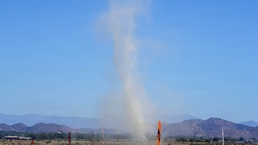
Dust devils began spinning across the drop zone on day two, and the championship stopped.
For roughly two and a half hours, the aircraft stayed grounded and the scoreboard stayed frozen. The extended delay broke the rhythm teams had built through the first six rounds.
Six rounds were finished. Two remained. The Golden Knights had built a commanding lead and could do nothing with it except wait for the air over Perris to settle.
But waiting was something they had prepared for.
“Each of us has a way to extract ourselves from the competition in the downtime and conserve our mental acuity,” George said. “With that preparation, the weather hold was kind of nice.”
O’Rourke found another benefit.
“Really, the weather hold allowed me to not have to worry about the winds at landing altitudes and focus more on the dive,” O’Rourke said.
When competition resumed, the Golden Knights scored 19 in round seven and 17 in round eight.
Their final line read: 21, 22, 20, 24, 20, 25, 19, 17.
Total: 168.
Average: 21.0.
DeLand Hard Deck Heros finished at 106, averaging 13.3, leaving the Golden Knights with a 62-point margin of victory.
For Elsinore Too Wrapped Up and Bad Advice Club, the competition was not quite over. Both finished the eight scheduled rounds at 101, averaging 12.6.
They returned the morning of Sept. 5 to settle it.
Elsinore scored 13.
Bad Advice scored 11.
Third place belonged to Elsinore.
There is another reason George believes the name “2-way” does not tell the whole story.
“Let’s not forget about our videographer,” George said. “This sport should not be called 2-way, as the videographer is highly involved. He knows the flow and positions himself rapidly in order to get the best angle for each point.”
That videographer is Ramirez.
His job is easy to overlook until something goes wrong.
Canopy formation is judged from air-to-air video. Judges have to see the formations clearly enough to determine whether every point actually happened, and the footage has to reach them within the required time.
Guest team Qatar A, which competed alongside the U.S. field but was not eligible for placement in the national standings, learned how unforgiving that process can be on the first day when a delay in turning in its footage resulted in a 20% deduction.
For Ramirez, getting the shot begins long before he leaves the aircraft.
Once the competition draw is released, O’Rourke and George rehearse each sequence on the ground called a dirt dive. Ramirez rehearses with them, but he sees the same dive differently.
“While Morgan and Ryan dirt dive each round, I make sure to follow along,” Ramirez said. “I look at the formation in a different way and visualize which way they will turn after each point.”
Then he has to translate that picture into three dimensions while flying his own parachute.
O’Rourke and George leave turbulent, disturbed air behind their canopies as they turn and dive — what canopy pilots call “dirty air.” That turbulence can reduce the lift and performance of Ramirez’s canopy, causing it to slow or drop just as he is trying to stay close enough to capture the next point.
“As they perform the dive, they produce a big surface of dirty air that can decrease how fast my parachute flies,” Ramirez said. “So it’s really important that I find the clean, smooth air to remain at a close distance to them at all times.”
Close is not enough.
The angle has to be right.
“The pressure is high,” Ramirez said. “The angle has to be just right to show clear separation of the foot as it leaves and grabs every line or grip taken.”
He has to anticipate where O’Rourke and George are going, avoid the disturbed air coming off their canopies, keep pace with them and give the judges an unobstructed view of every scoring formation.
Then he has to get the footage to the judges.
The camera flyer is not documenting the competition from the outside.
He is part of the competition.
“There’s a difference between being a camera flyer and a world-class camera flyer,” Ramirez said. “Anyone can put on a GoPro and film a skydive, but it takes a lot of training and passion to produce not good, but great quality footage.”
Ramirez knows the difference from both sides of the lens.
On July 18, 2025, at Netheravon Airfield in Wiltshire, England, he was not filming.
He was in the formation.
Ramirez, George and O’Rourke joined British Army Red Devils Steve Handley, Ryan Moult and Cam Clark for something that had never been done.
Six jumpers exited at 14,000 feet.
By 9,700, they had built a six-stack.
At 6,500 feet, they transformed it.
The formation rotated outward until all six connected parachutes were diving toward the ground in a full six-way downplane — the first ever completed.
They called it "The Hex."
Outside the formation was Red Devils photographer Ollie Goss.
From Ramirez’s perspective, Goss had the harder assignment.
“Ollie Goss had to position himself in an advantageous position for ‘The Hex’ to film the build of the stack and capture the formation split and downplane into the world’s first six-way downplane,” Ramirez said. “All without the use of a radio to communicate with the jumpers.”
At Perris, Ramirez receives the competition draw the night before and can prepare for what O’Rourke and George will do. He also has radio communication with them if he falls behind.
Goss had neither luxury while documenting a formation nobody had ever completed before.
“Bottom line, ‘The Hex’ was definitely harder to capture,” Ramirez said. “I’m very proud of Ollie Goss for taking video and pictures of a world’s first that I had the honor of being a part of.”
For George and O’Rourke, getting to this point required a transition of their own.
Both previously served as leaders of Golden Knights demonstration teams. Those jobs put them in charge of Soldiers performing at airshows, stadiums and public events across the country, but left little time to build a competitive canopy formation team.
“We didn’t,” George said when asked how they developed their competition skills while serving as demonstration team leaders. “As a team leader for a demonstration team, you have very little bandwidth or time for the extracurricular.”
They continued learning, practicing and teaching demonstration canopy relative work, which George said contributed to their confidence and understanding of canopy control.
It did not prepare them for everything that followed.
“Competitive 2-way sequential CF was unlike anything I have ever done,” George said. “It was not only physically and mentally demanding to learn the mechanics of each move, but it was also incredibly logistically challenging.”
The challenge was not simply learning to fly faster.
They had to build a team.
“We had to develop a team rather than just naming a team,” George said. “Which means we had to navigate each other’s personalities throughout the challenges of the year.”
The work produced a national championship seven months after they began competing together.
Now it has produced another.
Two seasons together.
Two national titles.
All three were selected to the United States Canopy Formation Team following their first championship.
For O’Rourke, defending the title was about more than adding another medal.
“It’s a testament to the hard work that we put in for one another, the Golden Knights and the Army as a whole,” O’Rourke said. “I think we showed some good improvement over last year. I hope to gain the respect, admiration and confidence in our country’s decision to have the three of us represent the USA this year and hopefully years to come.”
That improvement will be tested again soon.
The most interesting numbers at Perris may have been the ones that did not count toward the U.S. standings.
Qatar A competed as a guest team and posted 24, 30, 21, 24, 25, 32, 24 and 23 across eight rounds.
Total: 203.
Average: 25.4.
Thirty-five points more than the Golden Knights.
And its official score came after the 20% deduction for late video submission on the first day.
Qatar A’s 32-point sixth round was also seven points higher than the Golden Knights’ best round of 25.
As a guest team, Qatar A was outside the U.S. national standings, so none of it changed who left Perris as national champion.
It does change the conversation about what comes next.
The 22nd FAI World Canopy Formation Championships are scheduled for Oct. 8-14 at Skydive Elsinore in Lake Elsinore, California, roughly 30 miles from Perris.
There, Qatar will not be a guest. Nor will be the French team
There are five weeks between the national championship and the world championship.
At Perris, the Golden Knights proved they remain the best American team in 2-way sequential canopy formation.
At Elsinore, being the best American team will only get them through the door.
Formed in 1959, the U.S. Army Parachute Team’s competition squads have earned more than 50 national-level titles and hundreds of medals in national competition. The team adopted the Golden Knights name in 1961 — “Golden” for the gold medals its members had already won and “Knights” for having conquered the skies.
Assigned to U.S. Army Recruiting Command, the Golden Knights perform and compete across the United States and internationally in support of Army recruiting and community outreach.
The work toward worlds began before the national championship ceremony was even over.
From Perris, O’Rourke, George and Ramirez headed to Lake Elsinore, California, for another week of training before returning to North Carolina to keep building toward October.
The goal is roughly 150 more jumps before registration for the World Championships opens Oct. 8.
Point by point. Lift after lift. Jump after jump.
The national title is defended.
Now they are chasing the world.
-30-