In a major advancement for military medicine and battlefield survival, the Defense Health Agency helped secure Food and Drug Administration approval for a lifesaving product designed to stop uncontrolled bleeding in the most remote environments.
Marketed under the name EZPLAZ Freeze-Dried Plasma and manufactured by Teleflex, the product provides front-line military medical providers with a stable, highly portable treatment for severe injuries when traditional blood products are unavailable.
"Securing FDA approval for freeze-dried plasma is a key step forward for military medicine, and it speaks directly to our primary mission: keeping our joint force ready and bringing our warfighters home alive,” said DHA Director Navy Vice Adm. Darin K. Via. “The reality of future conflict means our medics will be operating in highly distributed, austere environments where traditional supply chains may not reach. By turning a fragile, refrigerated blood product into a rugged, shelf-stable tool that fits in a medic's pack, we are effectively pushing lifesaving capabilities right to the point of injury.”
Plasma is the liquid portion of blood that contains essential proteins necessary for clotting. When a warfighter suffers severe trauma, rapid transfusion of plasma is critical to prevent fatal blood loss. However, traditional liquid plasma requires freezing or strict refrigeration, making it nearly impossible to transport and store in austere environments. Freeze-dried plasma, or FDP, solves this long-standing logistical challenge: It is shelf-stable, easily carried by medics, and can be rapidly reconstituted with water for field use.
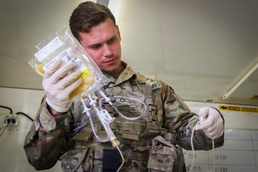
In addition, unlike other FDP products stored in glass containers, the new product utilizes a patented, flexible plastic bag. This eliminates the risk of bottle breakage and simplifies repacking, making the product far more durable and better suited for the harsh physical realities of far-forward combat operations.
Uncontrolled hemorrhage remains the leading cause of preventable death on the battlefield, especially when time and distance impede immediate evacuation. Recognizing that early transfusions of blood components dramatically improve survival rates, the Department of War has long championed FDP as a key capability to bridge the gap between the point of injury and surgical intervention in expansive theaters like the Indo-Pacific and Arctic regions.
The urgent need for a field-deployable plasma supply was the primary catalyst behind Public Law 115-92, which was enacted in 2017 specifically to facilitate enhanced engagements between the DOW and the FDA to accelerate the development of critical military medical products.
Development and management of FDP over the past decade was spearheaded by the Warfighter Protection and Acute Care Program Management Office. Operating under DHA’s Research, Development & Acquisition/Component Acquisition Executive office, the WPAC team used the authorities of P.L. 115-92 to work closely with the FDA, addressing regulatory hurdles to bring this capability to the front lines.
"The WPAC PMO collaborates with companies to develop products to address the Department of War’s mission-critical medical priorities,” said Kendra Lawrence, Ph.D., WPAC’s project manager. “Warfighter emergency medical care relies, in part, on bringing shelf-stable and easy-to-transport blood products to the front lines of the battlefield where they are most needed.”
WPAC is now actively managing the procurement and distribution of EZPLAZ FDP alongside the Armed Services Blood Program. A key partner in the rollout process, ASBP manages the blood and blood component supply for the military. The ASBP is the central driver of collection, manufacturing, storage, and delivery of blood products for the individual service branches globally.
Moving forward, FDP will be added to the blood provision capabilities of the military. Because this is the first FDP product to receive full FDA licensure rather than an Emergency Use Authorization, it eliminates the administrative reporting burdens previously placed on medical staff, allowing them to focus more on patient care.
According to Army Col. Jason Corley, director of ASBP, this full approval will have immediate impact in both civilian and military healthcare systems at home and abroad.
“FDP is a huge step forward at ensuring our warfighters at and near the front lines have the lifesaving supplies they need to address uncontrolled hemorrhage in far-forward, austere environments,” said Corley. “The military has focused heavily on developing this capability because it is widely needed and broadly applicable in both military and civilian healthcare settings when whole blood is unavailable or in short supply.”
By mitigating the challenges of time and distance, the FDA-approved FDP product is expected to have an immediate impact on front-line combat casualty care.
“Blood products are a critical and urgent need across the Department of War and the service branches, and FDP is a game changer,” said Andy Atkinson, the FDP product manager with WPAC. “Because it is so user-friendly, portable, shelf-stable, and rapidly reconstituted, it is form-fitted for use by both conventional and special forces anywhere in the world.”