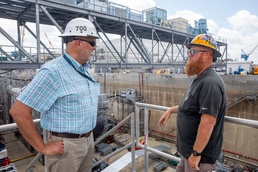
For many leaders, managing workloads and developing a team can feel like trying to juggle an invisible set of priorities. But for Joseph Singer, Norfolk Naval Shipyard’s (NNSY) Lifting and Handling (Code 700) Director, the solution is surprisingly simple: three buckets that are helping to transform his department.
The Lifting and Handling Department is a vital artery for the shipyard, a 635-person team responsible for the certification and operation of NNSY’s 16 massive portal cranes and all other auxiliary lifting equipment. From a small valve to a massive piece of superstructure, nothing moves on the waterfront, in the dry docks, or on the piers without Code 700’s involvement.
When Singer took the helm of the department in February, he brought with him decades of leadership experience, both as a civilian manager and as a retired U.S. Navy Lieutenant Commander. He noticed a need to unify the team and break down the silos that had formed over the years. To do that, he introduced a visualization tool he first developed back in 1995 while still in uniform: The Three Bucket Program.
“The buckets are a visualization of the work that you have in your queue,” Singer explained. “It's about delegating to the right authority so that you can develop people when you need to.”
The system is broken into three distinct categories:
The Big Bucket: “Fire and Forget.” This represents tasks that a leader should delegate to their staff with full trust. However, Singer points out that personally performing tasks in this bucket isn’t a sign of failure. “It is simply a representation of where you're focusing your attention,” he said. “Once you have that self-awareness, then you can take the steps you need to get back into the smaller buckets.”
The Middle Bucket: “Fire and Check.” This contains tasks delegated to capable team members who still require training and development before they can operate with full autonomy. These tasks demand active oversight and feedback.
The Small Bucket: “Just for You.” This holds the critical, non-delegable tasks that only the leader can perform. “This bucket must remain incredibly small,” Singer emphasized. “Otherwise, you will overload yourself and completely stall your team’s professional development.”
Initially, the program was met with some resistance. When Singer first assessed his leadership team and placed most of them in the “Big Bucket,” the reaction was tense. “They were all very upset because they thought the process was detrimental,” he recalled. “I had to sit them down and explain how the framework actually worked.”
The turning point came when the team saw the program in action. “The first time I moved someone out of that big bucket and into the middle one, they all bought in,” Singer said. “You could see it on that person's face. They realized, ‘Okay, now I'm doing something good.’ From that point on, everyone was fighting to get into that little bucket.”
John Foster, the Code 740 Deputy Superintendent, admitted he was “a bit surprised” at first, but now embraces the program. “I enjoy the interactive aspect of it,” he said. “The collaboration with my immediate team, we all can have the same drive to get to the middle bucket of success while still working diligently for the small bucket, where the team is totally functioning with little to no interaction.”
This structured approach, combined with other tools like a leadership talent assessment, has fostered a new sense of teamwork. “Now when somebody is in the big bucket, the team rallies,” Singer shared. “I’ll hear about five people immediately stepping up to ask, 'Hey, what can I do to help you delegate this and get out of that bucket?' The daily collaboration is much, much better.”
This cultural shift is central to Singer’s leadership philosophy, which he says is built on accountability, praise, and operating with love. “If you have a child and he touches the stove, you smack his hand. That's not being mean; that's still love because you don't want him to be hurt,” he analogized. “True leadership requires that same balance of positive reinforcement and firm correction. You must have both good and constructive accountability.”
Singer, who has been a civilian at the shipyard since 2014 after a 25-year Navy career, sees himself as a leader first and foremost. “I'm not a rigger, I'm not a facilities guy… I'm a leader,” he stated. “Leadership doesn't stop when you go through the shipyard gate. You carry that responsibility everywhere you go.”
His ultimate goal is to tear down the walls that have historically isolated Code 700 from the rest of the shipyard, transforming the department into a model organization. With a new motto of “mission delivery through lifting and handling excellence,” Singer is confident his team is firmly on the path to becoming the shipyard’s gold standard.
Foster agrees that the shift is underway. “Taking this huge step has allowed Code 700 to turn the corner with a highly functioning workforce driven by a shared, success-oriented mindset,” he said.
Ultimately, the Three Bucket Program has provided the team with far more than just a management framework – it has given them a common language for growth. By encouraging leaders to minimize their “Just for You” bucket and trust their teams with the other two, Singer is building a department that is both highly efficient and more unified. For Code 700, the goal is no longer just to complete the next lift. It is about filling the right buckets, empowering the workforce, and in doing so, truly becoming the gold standard for lifting and handling from within America's Shipyard.